
EDI Mapping Software That Eliminates Errors and Speeds Integration
Modern EDI environments fail when data mapping is rigid, manual, or slow.
EZConnect’s EDI mapping software removes that friction by automating how data is translated, mapped, and delivered between your ERP systems and trading partners—in real time.
Instead of wrestling with custom code, batch delays, and partner-specific exceptions, your team gains a faster, more reliable way to keep transactions flowing accurately and compliantly.
- Reduce costly EDI errors and chargebacks with automated, standards-compliant data mapping and validation
- Accelerate trading partner onboarding using drag-and-drop mapping—no custom coding required
- Move data in real time, not batches, so orders, invoices, and ASNs flow in minutes instead of days
Why EDI Data Mapping Breaks Down in Real-World Environments
EDI mapping is the foundation of every successful EDI transaction—but when it’s handled manually or with outdated tools, small data issues quickly turn into operational problems. As trading partners, ERP systems, and compliance requirements change, rigid EDI mapping approaches can’t keep up. The result is lost time, higher costs, and unnecessary risk across your supply chain.
Data Errors & Chargebacks
Mismatched fields, incorrect formats, and manual re-entry lead to rejected transactions, chargebacks, and strained partner relationships.
Slow Partner Onboarding
Each new trading partner requires custom mapping work, delaying go-live timelines and slowing revenue-generating transactions.
Heavy IT Dependence
Custom-coded mappings mean every change requires developer time, creating bottlenecks and pulling IT away from higher-value work.
Batch Delays & Limited Visibility
Batch-based processing hides errors until it’s too late, delaying orders, invoices, and acknowledgments by hours—or days.
Compliance & Audit Risk
Inconsistent mappings make it harder to meet X12, EDIFACT, and customer-specific requirements, increasing audit and compliance exposure.
Poor EDI data mapping leads to rejected transactions, delayed payments, compliance risk, and wasted IT time.
What Is EDI Data Mapping
EDI data mapping is the process of translating data from your internal systems—such as ERP, WMS, or accounting software—into the EDI formats required by your trading partners, and back again. Every order, invoice, shipment notice, and payment depends on accurate mapping. When mapping is flexible and automated, EDI becomes a competitive advantage. When it isn’t, it becomes a constant source of errors, delays, and rework.
Key Elements of Effective EDI Data Mapping
How EZConnect Solves EDI Mapping at Scale
EZConnect was built for organizations that manage complex, high-volume EDI environments and can’t afford mapping bottlenecks. Instead of relying on brittle, one-off mappings or outsourced services, EZConnect gives your team a flexible, real-time EDI mapping platform that adapts as partners, systems, and requirements change—without slowing your business down.
Map and translate data between EDI, XML, flat files, databases, and APIs—so all systems speak the same language without manual rework.
Create and update EDI mappings visually, eliminating dependency on custom scripts and freeing IT teams from constant maintenance.
Process EDI data directly into ERP and database tables as transactions occur, reducing document exchange times from days to minutes.
EZConnect can auto-configure new trading partners from inbound EDI/XML documents, dramatically reducing onboarding time and effort.
Instead of rejecting entire files, EZConnect isolates incomplete or inaccurate data for correction—keeping valid transactions moving.
Track every transaction at the document level to support X12, EDIFACT, and regulatory compliance with complete visibility.
EDI Mapping Tools That Work the Way Your Team Works
Your EDI mapping tools shouldn’t force your team into rigid workflows or constant workarounds. EZConnect is designed to support how integration teams actually operate—combining visual mapping, real-time control, and flexibility for both technical and non-technical users. The result is faster execution, fewer errors, and less reliance on specialized coding skills.
Visual, Drag-and-Drop Mapping
What This Solves
Any-to-Any Translation Engine
What This Solves
Built for Technical Control
What This Solves
Real-Time Visibility & Control
What This Solves
Real-Time EDI Translation and Data Mapping
Legacy EDI systems rely on batch jobs, intermediary files, and delayed processing—creating blind spots that slow transactions and increase risk. EZConnect replaces that model with real-time EDI translation and data mapping, processing transactions as they occur and delivering data directly into your ERP and database systems. The result is faster execution, immediate visibility, and a more resilient EDI operation that keeps pace with your business.
Traditional EDI mapping tools process data in scheduled batches, which means orders, invoices, and acknowledgments can sit idle for hours before being acted upon. EZConnect processes EDI and XML transactions in real time, translating and mapping data the moment it is received. By eliminating staging files and batch dependencies, businesses can reduce document exchange cycles from days to minutes and respond instantly to operational events as they happen.
Many EDI platforms rely on intermediate files that must be imported, transformed, or reconciled before data becomes usable. EZConnect maps EDI data directly into ERP systems and database tables, ensuring transactions are immediately available to downstream processes like order fulfillment, billing, inventory updates, and reporting. This direct integration reduces manual intervention, eliminates synchronization issues, and ensures data consistency across systems.
In batch-based environments, mapping errors often go unnoticed until an entire file is rejected or a trading partner raises an issue. EZConnect detects incomplete or inaccurate data in real time and manages issues by exception rather than rejection. Only the affected transactions are staged for correction, while valid data continues to flow uninterrupted. This approach dramatically reduces downtime, rework, and partner frustration.
Without real-time insight, teams are left guessing where transactions stand and why delays occur. EZConnect provides full, document-level visibility into every transaction as it moves through the EDI lifecycle—sent, received, acknowledged, accepted, or flagged. This transparency enables faster decision-making, quicker issue resolution, and smoother collaboration with trading partners, ultimately accelerating order-to-cash and procure-to-pay cycles.
The Role of Data Mapping in Modern EDI Solutions
In modern EDI environments, data mapping is no longer a one-time setup—it’s an ongoing capability that determines how fast, accurate, and resilient your integrations are. As ERP systems evolve, trading partners change requirements, and businesses move toward real-time operations, flexible data mapping becomes the backbone of scalable EDI solutions. Without it, automation breaks down and EDI quickly becomes a bottleneck instead of an advantage.
Data Accuracy & Transaction Reliability
Accurate data mapping ensures that every EDI transaction aligns correctly with internal systems and external standards. When fields, formats, and values are mapped properly, businesses avoid rejected documents, chargebacks, and time-consuming manual corrections—keeping transactions reliable from the start.
Real-Time Processing & Faster Business Cycles
Modern EDI depends on data mapping that can operate in real time. Flexible mapping enables transactions to be translated and delivered instantly, eliminating batch delays and allowing orders, invoices, and acknowledgments to move in minutes instead of days.
Trading Partner Flexibility
No two trading partners implement EDI standards exactly the same way. Effective data mapping allows modern EDI solutions to adapt to partner-specific requirements—handling variations, optional segments, and custom rules without duplicating logic or creating fragile integrations.
System Stability, Compliance & Change Management
As ERP systems are upgraded and regulations evolve, adaptable data mapping acts as a buffer that protects core applications. It helps maintain compliance with standards like X12 and EDIFACT while absorbing change without disrupting ongoing operations.
Types of EDI Mapping
Not all EDI mapping approaches are created equal. The type of mapping model you use has a direct impact on how scalable, maintainable, and future-proof your EDI environment will be. Understanding the two primary types of EDI mapping helps explain why some integrations become brittle over time—while others adapt easily as partners and systems change.
Direct Mapping (1:1 Mapping)
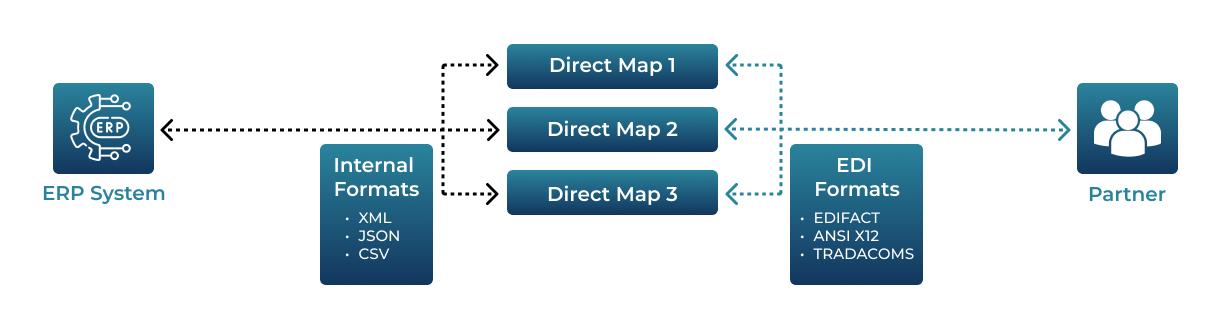
Direct mapping creates a one-to-one relationship between a sender’s data format and a receiver’s data format. Each trading partner requires its own custom mapping that directly translates fields from one structure to another.
This approach is often used in simple EDI environments with a small number of trading partners or limited transaction types.
As the number of partners grows, direct mapping becomes difficult to manage. Every new partner or change requires building and maintaining additional mappings, increasing complexity, maintenance effort, and risk of errors.
Direct mapping works for small, static EDI networks—but it does not scale well as business requirements evolve.
Indirect Mapping (Canonical Mapping)
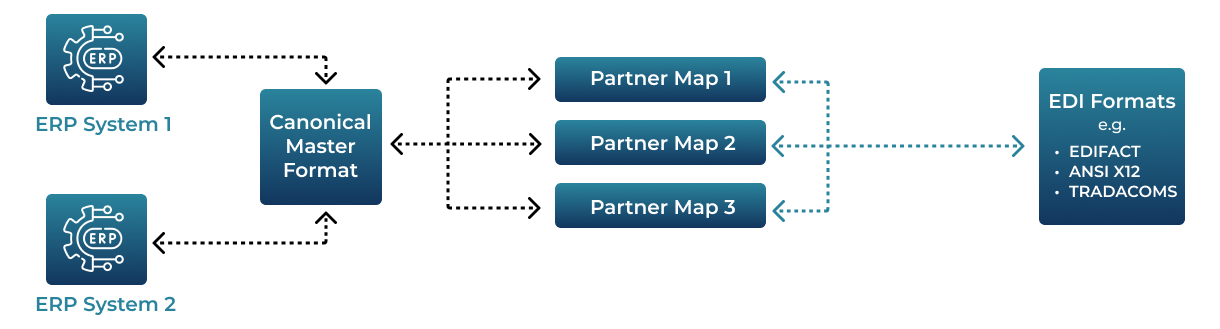
Indirect, or canonical, mapping introduces an intermediate data model between trading partners. Instead of building unique 1:1 mappings for every partner pair:
Each trading partner’s EDI message is mapped to a standardized internal (canonical) format
A separate mapping then converts that canonical format into the target system’s structure (such as an ERP or database format)
This approach dramatically reduces the number of mappings required. Internal systems only map once to the canonical model, while partner-specific mappings remain isolated and easier to manage.
Canonical mapping is the foundation of modern, scalable EDI solutions—especially for organizations with growing partner networks and complex ERP environments.
See How Modern EDI Mapping Should Work
EDI mapping doesn’t have to be complex, fragile, or slow. With EZConnect, you can automate EDI data mapping and translation in real time—reducing errors, accelerating partner onboarding, and keeping your ERP systems running smoothly as your business grows. Request a personalized demo to see how EZConnect simplifies EDI mapping at scale and delivers faster, more reliable integrations across your trading partner network.