
What Is EDI? (EDI Meaning Explained)
EDI, or Electronic Data Interchange, is the standardized, computer-to-computer exchange of business documents between organizations—without manual data entry, emails, or paper.
Instead of employees re-keying purchase orders, invoices, shipping notices, or payment information, EDI allows systems to communicate directly with each other in a structured, machine-readable format. This automation dramatically reduces errors, speeds up transactions, and lowers operational costs.
In simple terms, EDI replaces manual document handling with automated digital workflows. When one company sends an order, invoice, or shipment update, EDI ensures that data flows instantly and accurately from one system to another—whether that’s an ERP, accounting system, warehouse management system, or trading partner platform.
What Does EDI Stand For?
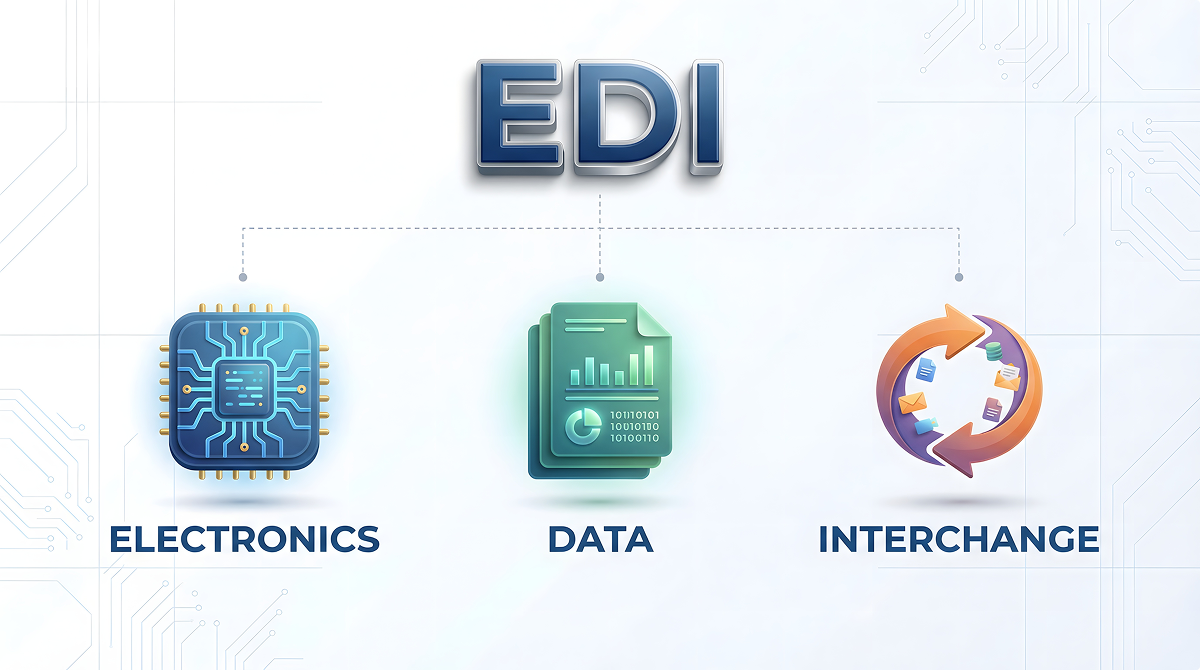
EDI stands for Electronic Data Interchange:
- Electronic – Data is exchanged digitally
- Data – Business-critical information (orders, invoices, payments, etc.)
- Interchange – Information flows between separate organizations and systems
Why EDI Matters for Businesses
Companies that rely on manual processes often face:
- Data entry errors and duplicate payments
- Delays in order-to-cash and procure-to-pay cycles
- Missed compliance requirements from trading partners
- Limited visibility into transactions across systems
EDI addresses these challenges by automating how data moves between businesses, enabling faster decision-making, better compliance, and more scalable operations.
In the sections below, we’ll break down:
- How EDI works step by step
- What an EDI system and EDI transactions look like
- The role of EDI software, integration, mapping, and compliance
So you can clearly understand what EDI is, how it works, and why it’s a foundational technology for modern B2B operations.
How EDI Works: Step-by-Step
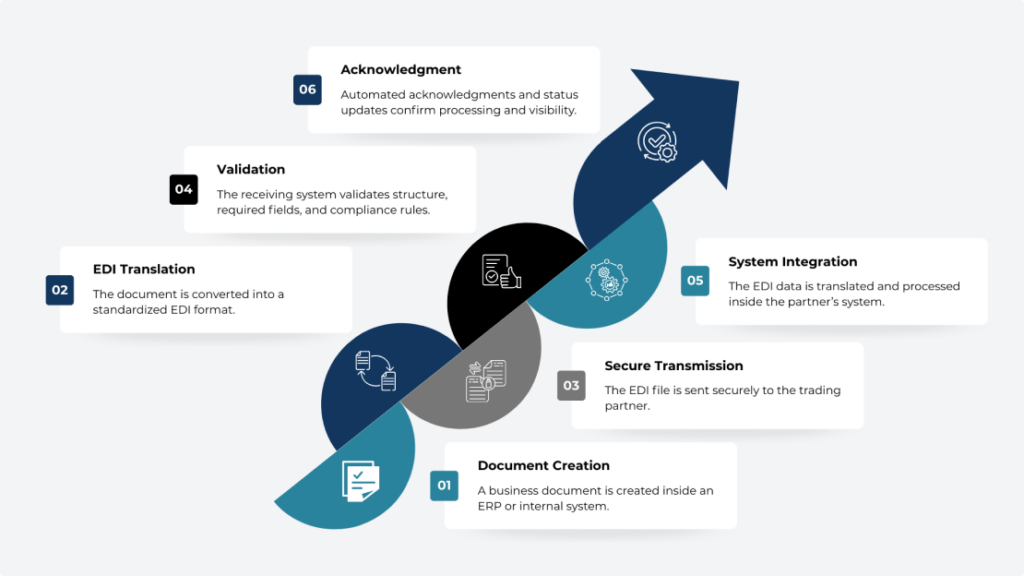
At its core, EDI automates how business documents move between companies and systems. While the technology behind it is sophisticated, the actual EDI process follows a straightforward, repeatable flow.
Here’s how an EDI transaction typically works from start to finish.
Step 1: A Business Document Is Created
An EDI process begins when a business document is generated inside a company’s internal system, such as an ERP, accounting platform, or warehouse management system.
Common examples include:
- A purchase order created in an ERP
- An invoice generated after goods are shipped
- A shipping notice created by a warehouse system
At this stage, the document is still in the company’s internal format, not EDI.
Step 2: Data Is Translated Into an EDI Format
Next, the internal document is converted into a standardized EDI format that the trading partner’s system can understand.
This process is called EDI translation and involves:
- Mapping internal data fields (e.g., customer ID, item number, quantity)
- Converting them into standardized EDI segments and elements
- Ensuring the document follows the correct EDI standard (such as ANSI X12 or EDIFACT)
This step is critical because different companies use different systems, but EDI provides a common language between them.
Step 3: The EDI File Is Transmitted Securely
Once translated, the EDI document is sent electronically to the trading partner using a secure communication method.
Common EDI communication methods include:
- AS2
- SFTP / FTP
- VANs (Value-Added Networks)
- Web services or APIs (in modern EDI environments)
Security, encryption, and tracking are essential here to ensure documents are delivered reliably and compliantly.
Step 4: The Trading Partner Receives and Validates the Document
When the trading partner receives the EDI file, their EDI system:
- Confirms the document structure is valid
- Verifies required fields are present
- Checks compliance with trading partner rules
If issues are found, the transaction may be flagged for correction. If everything is valid, processing continues automatically.
Step 5: Data Is Translated Back Into the Partner’s System
The EDI document is then translated from EDI format back into the trading partner’s internal system format.
For example:
- An EDI purchase order becomes a sales order in the supplier’s ERP
- An EDI invoice becomes an accounts payable entry
This step enables straight-through processing, eliminating manual data entry entirely.
Step 6: Acknowledgments and Status Updates Are Exchanged
Most EDI workflows include automated acknowledgments and responses, such as:
- Confirmation that a document was received
- Status updates (accepted, rejected, shipped, invoiced)
- Error notifications when corrections are needed
This creates real-time visibility into transactions across both organizations.
Why This Process Matters
Because EDI follows this automated, system-to-system flow:
- Transactions move in minutes instead of days
- Manual errors and re-keying are eliminated
- Compliance with trading partner requirements is enforced automatically
- ERP, accounting, and supply chain systems stay synchronized
In the next section, we’ll look more closely at EDI transactions themselves—what they are, common examples, and how they’re used in real business scenarios.
What Is an EDI Transaction?
An EDI transaction is a single, structured electronic document exchanged between two business systems using EDI standards. Each transaction represents a specific business action—such as placing an order, sending an invoice, or confirming a shipment.
Instead of sending PDFs, emails, or spreadsheets that require human review and manual entry, an EDI transaction allows systems to communicate directly, ensuring data is processed automatically and consistently on both sides.
How EDI Transactions Are Used in Real Life
To understand EDI transactions, it helps to look at a common business scenario.
A retailer creates a purchase order in its ERP system. That order is automatically converted into an EDI transaction and sent to a supplier. The supplier’s system receives it, validates the data, and creates a corresponding sales order—without anyone typing or re-keying information.
That single exchange is one EDI transaction.
As the process continues, additional EDI transactions are exchanged to confirm shipment, send an invoice, and acknowledge receipt. Each step is tracked, validated, and logged electronically.
Common Types of EDI Transactions
EDI transactions are identified by standardized document codes. While there are hundreds of possible transaction types, most businesses rely on a core set.
The most common EDI transactions include:
- Purchase Orders (EDI 850) – Sent by a buyer to request goods or services
- Invoices (EDI 810) – Sent by a supplier to request payment
- Advance Ship Notices (EDI 856) – Sent to notify a buyer that goods have shipped
- Functional Acknowledgments (EDI 997) – Sent to confirm receipt and validity of a document
Each transaction type follows a predefined structure so that systems on both sides interpret the data the same way.
What Does an EDI File Look Like?
An EDI file is not designed to be human-readable. It consists of segments and data elements arranged in a precise order, separated by delimiters.
While it may look complex to the human eye, this structure is what allows computers to:
- Validate documents automatically
- Enforce compliance rules
- Process large transaction volumes quickly and accurately
This is why EDI files are typically handled by EDI software, which translates them into readable formats for internal systems and users.
Why EDI Transactions Matter
EDI transactions are the foundation of automated B2B workflows. Because each transaction is standardized and validated:
- Errors are caught before they impact operations
- Processing times shrink from days to minutes
- Compliance requirements are enforced automatically
- Systems stay synchronized across organizations
For companies exchanging hundreds or thousands of documents per month, EDI transactions eliminate manual bottlenecks and enable true system-to-system automation.
In the next section, we’ll explore EDI standards—the rules that define how these transactions are structured and why standards are critical for interoperability.
EDI Standards Explained (X12, EDIFACT, and More)
EDI only works because both the sender and receiver follow the same set of rules. These rules are known as EDI standards, and they define how electronic documents are structured, formatted, and interpreted by computer systems.
Without standards, each company would format documents differently, making automated system-to-system communication impossible. EDI standards ensure that a purchase order, invoice, or shipment notice means the same thing—no matter which systems or organizations are involved.
What Are EDI Standards?
An EDI standard is a shared framework that specifies:
- Which data elements must appear in a document
- The order those elements appear in
- How values such as dates, quantities, and identifiers are formatted
- How documents are validated and acknowledged
By using standardized formats, businesses can exchange data reliably without custom integrations for every trading partner.
ANSI X12 (The Most Common Standard in North America)
ANSI X12 is the most widely used EDI standard in the United States and Canada. It is governed by the Accredited Standards Committee (ASC X12) and is commonly used across retail, manufacturing, healthcare, logistics, and finance.
In X12, each document type is identified by a three-digit transaction set number. For example:
- 850 represents a purchase order
- 810 represents an invoice
- 856 represents an advance ship notice
X12 standards are highly structured and versioned, meaning trading partners must often agree on a specific version to ensure compatibility.
EDIFACT (International EDI Standard)
EDIFACT (Electronic Data Interchange for Administration, Commerce, and Transport) is the dominant EDI standard used outside North America, particularly in Europe and other global markets.
While EDIFACT serves the same purpose as X12, its structure and syntax differ. Organizations doing business internationally often need EDI systems that can support both standards and translate between them when necessary.
ANSI X12 vs. EDIFACT: A Simple Comparison
| Feature | ANSI X12 | EDIFACT |
|---|---|---|
| Primary Usage Region | United States & Canada | Europe and international markets |
| Governing Body | ASC X12 (Accredited Standards Committee) | United Nations (UN/CEFACT) |
| Common Industries | Retail, manufacturing, logistics, healthcare | Global trade, transportation, government |
| Document Identification | Numeric transaction codes (e.g., 850, 810, 856) | Alphanumeric message types (e.g., ORDERS, INVOIC) |
| Syntax Style | Segment-based with strict delimiters | Compact, syntax-driven structure |
| Versioning | Frequent version updates (e.g., 4010, 5010) | Stable international releases |
| Global Adoption | Primarily North America | Widely used worldwide |
| Interoperability | Strong within U.S. trading networks | Designed for cross-border transactions |
If your business trades only within North America, ANSI X12 is typically sufficient. But if you work with international customers, suppliers, or logistics providers, your EDI system must support both X12 and EDIFACT—and translate seamlessly between them.
This is where modern EDI software becomes critical, enabling businesses to exchange standardized documents across regions without custom development or manual intervention.
Other EDI Standards and Variations
Beyond X12 and EDIFACT, several other EDI standards exist to support specific industries or regions. These standards address unique regulatory, operational, or supply-chain requirements.
Some examples include:
- TRADACOMS, used primarily in the UK retail sector
- VDA, a standard developed by the German automotive industry for manufacturing and logistics transactions
- GS1 EDI, which defines global business rules and message subsets (often based on EDIFACT) for supply chains and logistics
- HIPAA EDI, which mandates the use of specific ANSI X12 transaction sets for healthcare transactions such as claims and eligibility in the United States
These standards are designed to meet industry-specific regulatory, operational, and compliance requirements.
Why EDI Standards Matter for Compliance and Automation
EDI standards do more than define document structure—they also support compliance and automation.
Because standards enforce consistent formatting and required fields, EDI systems can:
- Automatically validate incoming documents
- Reject or flag incomplete or incorrect data
- Enforce trading partner and regulatory requirements
- Maintain audit trails for compliance purposes
This consistency is what allows EDI to scale across hundreds or thousands of trading partners without manual intervention.
Standards Are the Foundation—Integration Makes Them Powerful
While EDI standards define the language, EDI integration determines how effectively that data flows into ERP, accounting, and supply chain systems. Modern EDI platforms don’t just translate standards—they integrate them directly into business applications so transactions can be processed in real time.
In the next section, we’ll look at what an EDI system is, the core components involved, and how EDI software brings standards, transactions, and integration together into a single automated workflow.
What Is an EDI System and EDI Software?
An EDI system is the combination of software, integrations, and processes that allow businesses to send, receive, translate, and process EDI transactions automatically. It acts as the bridge between your internal business systems and your trading partners’ systems.
EDI software is the technology that powers that system. It handles the translation, validation, communication, and integration required to move data accurately between organizations—without manual intervention.
While the terms are often used interchangeably, there is an important distinction:
- The EDI system is the full operational environment
- EDI software is the engine that makes it work
What Does an EDI System Do?
An EDI system manages the entire lifecycle of an EDI transaction. When a document is created in an ERP or accounting system, the EDI system ensures it is translated into the correct standard, securely transmitted to the trading partner, validated on receipt, and integrated into the receiving system.
A complete EDI system typically handles:
- Document translation between internal formats and EDI standards
- Secure transmission of EDI files
- Validation and compliance checks
- Error handling and acknowledgments
- Integration with ERP, WMS, CRM, or financial systems
- Monitoring, reporting, and audit trails
Without these components working together, EDI quickly becomes brittle, manual, and difficult to scale.
What Is EDI Software?
EDI software is the platform that enables all of this automation. It removes the need for manual data entry, scripting, or one-off integrations by providing standardized tools to manage EDI at scale.
Modern EDI software typically includes:
- Translation and mapping tools to align internal data with EDI standards
- Communication modules to send and receive documents securely
- Integration capabilities to connect directly to business systems
- Monitoring and exception handling to identify and resolve issues quickly
Rather than simply converting files, today’s EDI software focuses on real-time data flow, visibility, and reliability across trading partner networks.
On-Premise vs. Cloud EDI Software
EDI software can be deployed in different ways depending on a company’s infrastructure and control requirements.
On-premise EDI software runs within a company’s own environment. It offers greater control and customization and is often preferred by organizations with complex ERP systems or regulatory requirements.
Cloud-based EDI software is hosted by a provider and accessed as a service. It reduces infrastructure management and can speed up onboarding, but may offer less flexibility for deep system integrations.
Many organizations now use hybrid EDI systems, combining on-premise control with cloud connectivity for trading partners.
Managed EDI vs. Self-Managed EDI Software
Another key distinction is how much control the business maintains.
With managed EDI, a third party handles mapping, partner setup, and monitoring on the company’s behalf. This can reduce internal workload but often limits flexibility and increases long-term costs.
With self-managed EDI software, internal teams maintain control over integrations, mappings, and workflows. This approach provides greater transparency, faster change management, and scalability as business needs evolve.
Why the Right EDI System Matters
Choosing the right EDI system isn’t just a technical decision—it directly impacts operational efficiency, compliance, and growth.
A modern EDI system enables businesses to:
- Process high volumes of transactions without manual effort
- Onboard new trading partners faster
- Reduce data errors and chargebacks
- Maintain compliance with partner and industry standards
- Gain visibility into transactions across systems
In the next section, we’ll look more closely at EDI integration—how EDI systems connect directly to ERP, accounting, and supply chain platforms to enable true end-to-end automation.
What Is EDI Integration and How Does It Work?
EDI integration is the process of connecting EDI transactions directly to a company’s internal business systems—such as ERP, accounting, warehouse management, or CRM platforms—so data flows automatically without manual intervention.
Without integration, EDI is little more than electronic file exchange. With integration, EDI becomes a fully automated business process.
What EDI Integration Really Means
At a basic level, EDI integration ensures that when an EDI document is received or sent, the data doesn’t stop at a file or inbox. Instead, it flows directly into the system where work actually happens.
For example:
- An incoming EDI purchase order automatically creates a sales order in an ERP
- An EDI invoice posts directly to accounts payable
- A shipping notice updates inventory and triggers downstream workflows
This eliminates the need for employees to open files, re-key data, or manually reconcile documents.
How EDI Integration Works Behind the Scenes
EDI integration typically involves three coordinated steps.
First, the EDI software translates incoming or outgoing EDI documents into a structured data format that internal systems can understand.
Next, mapping rules align EDI data elements with specific fields in the ERP, accounting system, or database. This ensures that values like customer IDs, item numbers, quantities, and pricing land in the correct place.
Finally, the integrated system processes the transaction automatically—creating, updating, or validating records in real time.
This entire flow happens without human involvement, even when transaction volumes are high.
Batch vs. Real-Time EDI Integration
Not all EDI integrations work the same way.
Older or limited integrations rely on batch processing, where EDI files are collected and processed at scheduled intervals. While functional, this can introduce delays, errors, and visibility gaps.
Modern EDI integration supports real-time or near–real-time processing, where transactions are validated and posted immediately. This approach improves responsiveness, reduces reconciliation issues, and keeps systems continuously aligned across trading partners.
Why EDI Integration Is Critical to Automation
EDI by itself standardizes communication. Integration is what turns that communication into automation.
When EDI is tightly integrated:
- Orders move faster through order-to-cash cycles
- Invoices are processed with fewer errors and delays
- Inventory and shipment data stay accurate across systems
- Compliance rules are enforced automatically
- Staff are freed from repetitive, manual tasks
Without integration, companies often fall back on manual workarounds that undermine the value of EDI.
Common Challenges Without Proper EDI Integration
Organizations that lack strong EDI integration often experience:
- Manual re-entry of EDI data into ERP systems
- Delays caused by file-based or batch processing
- Errors from mismatched data formats or versions
- Poor visibility into transaction status
- Higher IT overhead to maintain custom scripts
These issues typically grow worse as transaction volume and trading partner complexity increase.
EDI Integration Is the Bridge Between Systems
Ultimately, EDI integration is what allows different businesses—and different technologies—to operate as a single, coordinated workflow.
It ensures that EDI transactions don’t just move between companies, but move through the business—driving speed, accuracy, and scalability across supply chains and financial operations.
In the next section, we’ll look at EDI mapping in more detail and explain why it’s one of the most important (and often misunderstood) parts of a successful EDI integration strategy.
What Is EDI Mapping and Why Is It Important?
EDI mapping is the process of aligning data from one system to another so information is translated correctly between internal applications and EDI standards.
In simple terms, mapping tells an EDI system where each piece of data should go and how it should be interpreted. Without proper mapping, even a correctly formatted EDI document can fail to process—or worse, process incorrectly.
What EDI Mapping Actually Does
Every business system stores data differently. An ERP might label a field “Customer Number,” while a trading partner’s EDI standard refers to it as a “Buyer ID.” EDI mapping ensures those two values are correctly matched.
When an EDI document is sent or received, mapping rules:
- Identify each data element in the EDI file
- Match it to the correct internal field
- Convert formats where necessary (dates, units of measure, codes)
This ensures that information such as item numbers, quantities, pricing, and addresses land in the right place—every time.
Why EDI Mapping Is Critical to Accuracy
EDI mapping is one of the most important factors in EDI accuracy and reliability. Poor or incomplete mapping can lead to serious business issues, including:
- Incorrect orders or invoices
- Inventory discrepancies
- Payment delays or chargebacks
- Compliance violations with trading partner requirements
Because EDI transactions are processed automatically, even small mapping errors can quickly multiply across hundreds or thousands of documents.
One-to-One vs. Trading Partner–Specific Mapping
In practice, EDI mapping is rarely “one size fits all.”
While EDI standards define a common structure, individual trading partners often impose their own requirements, such as mandatory fields, custom codes, or specific data formatting. This means businesses typically need:
- A base mapping aligned to the EDI standard
- Adjustments for each trading partner’s rules
Modern EDI systems manage this complexity by supporting reusable maps with partner-specific variations, rather than forcing companies to build everything from scratch.
Manual Mapping vs. Modern Mapping Tools
Historically, EDI mapping required custom coding and manual scripting, making changes slow, expensive, and dependent on specialized technical skills.
Today, modern EDI platforms provide visual, drag-and-drop mapping tools that allow users to:
- See how data flows between systems
- Make updates quickly as requirements change
- Reduce dependency on custom code
This flexibility is especially important when onboarding new trading partners or responding to version changes in EDI standards.
Why EDI Mapping Directly Impacts Scalability
As businesses grow, they add more trading partners, handle higher transaction volumes, and support more document types. Without scalable EDI mapping:
- Onboarding new partners takes longer
- Errors increase as complexity grows
- IT teams become bottlenecks
Strong mapping capabilities allow EDI systems to scale smoothly—supporting growth without adding manual work or risk.
Mapping Is the Foundation of Successful EDI Integration
EDI integration connects systems. EDI mapping makes that connection meaningful.
When mapping is done correctly:
- Data flows cleanly between systems
- Transactions process automatically and accurately
- Compliance rules are enforced consistently
- Businesses gain confidence in their automated workflows
In the next section, we’ll explore EDI compliance—what it means, why it matters, and how EDI systems help businesses meet trading partner and regulatory requirements.
What Is EDI Compliance and Why Does It Matter?
EDI compliance refers to meeting the technical, operational, and business rules required when exchanging EDI documents with trading partners. These rules ensure that EDI transactions are structured correctly, transmitted securely, and processed accurately by both parties’ systems.
In practice, EDI compliance isn’t optional. Many customers, suppliers, retailers, and logistics providers require compliance as a condition of doing business.
What EDI Compliance Actually Covers
EDI compliance goes beyond simply sending an EDI file. It includes adhering to multiple layers of requirements, such as:
- Using the correct EDI standard and version
- Following trading partner–specific document rules
- Sending required acknowledgments within defined timeframes
- Transmitting data securely using approved protocols
- Maintaining audit trails and transaction history
Even when two companies use the same EDI standard, compliance rules can vary significantly from one trading partner to another.
Trading Partner Compliance Requirements
Most compliance challenges come from trading partner mandates.
Large retailers, manufacturers, and distributors often publish detailed EDI guidelines that specify:
- Which EDI transaction types are required
- Mandatory fields and acceptable values
- Formatting rules and version numbers
- Timelines for sending acknowledgments and updates
- Penalties for errors, delays, or non-compliance
Failure to meet these requirements can result in chargebacks, delayed payments, or even termination of the business relationship.
Industry and Regulatory Compliance
In some industries, EDI compliance also supports regulatory requirements.
For example:
- Healthcare organizations must comply with HIPAA EDI standards
- Financial and logistics transactions often require detailed audit trails
- Public sector and government contracts may mandate secure, traceable EDI communication
EDI systems help enforce these requirements by validating data, tracking transactions, and retaining records automatically.
Why EDI Compliance Matters to the Business
Non-compliance isn’t just a technical issue—it has direct financial and operational consequences.
Poor EDI compliance can lead to:
- Chargebacks and fines from trading partners
- Rejected orders or invoices
- Delayed shipments and payments
- Increased manual intervention to fix errors
- Damaged customer and supplier relationships
On the other hand, strong EDI compliance enables smoother operations, faster cycles, and greater trust between trading partners.
How EDI Systems Support Compliance
Modern EDI systems are designed to enforce compliance automatically.
They help businesses:
- Validate documents before transmission
- Flag missing or incorrect data
- Enforce trading partner rules consistently
- Track acknowledgments and document status
- Maintain detailed audit logs for every transaction
By embedding compliance into the EDI workflow, businesses reduce risk without increasing manual oversight.
Compliance Is Ongoing, Not One-Time
EDI compliance isn’t a “set it and forget it” task. Standards evolve, trading partner requirements change, and businesses add new partners over time.
A scalable EDI system allows organizations to adapt quickly—updating rules, mappings, and validations without disrupting operations.
In the next section, we’ll bring everything together by looking at the key benefits of EDI and how EDI automation improves efficiency, accuracy, and scalability across the business.
Benefits of EDI for Modern Businesses
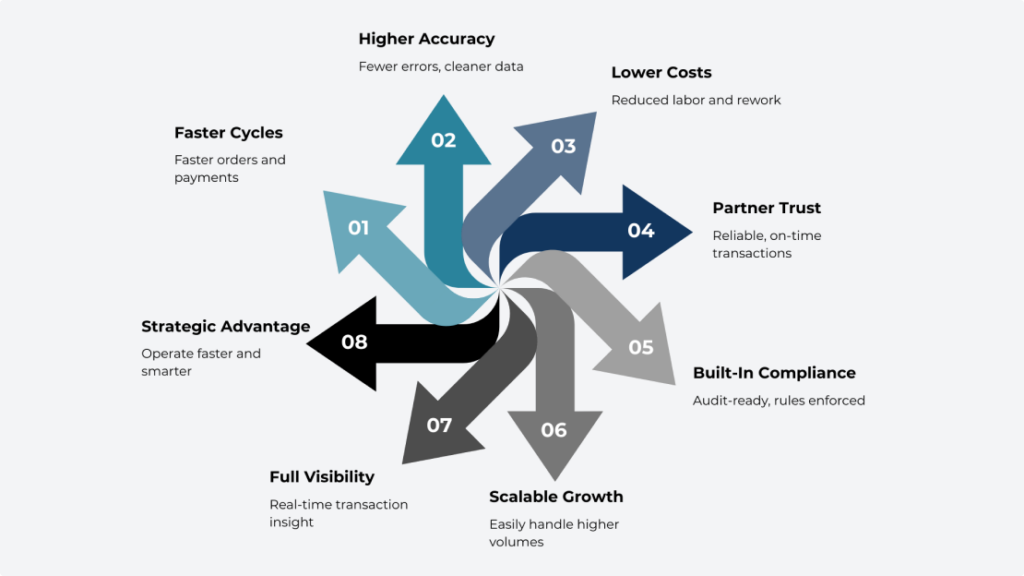
EDI is more than a way to exchange documents—it’s a foundational technology for automation, scalability, and operational control. When implemented and integrated properly, EDI delivers measurable improvements across finance, supply chain, and IT operations.
Faster Business Cycles and Improved Cash Flow
One of the most immediate benefits of EDI is speed.
By automating the exchange of purchase orders, invoices, and shipping notices, businesses can move from days of manual processing to near–real-time transactions. Orders are fulfilled faster, invoices are processed sooner, and payments are received more quickly—directly improving cash flow and working capital.
Reduced Errors and Higher Data Accuracy
Manual data entry is one of the biggest sources of operational errors. Typos, missing fields, and duplicate entries lead to rejected documents, delays, and costly rework.
EDI eliminates manual re-keying by allowing systems to communicate directly. With standardized formats, automated validation, and enforced mapping rules, businesses experience significantly higher data accuracy and fewer exceptions that require human intervention.
Lower Operational Costs
Processing documents manually is expensive. Labor, rework, printing, storage, and exception handling all add up quickly—especially at scale.
By automating document exchange and processing, EDI helps businesses:
- Reduce labor costs tied to manual data entry
- Minimize chargebacks and penalties from errors
- Eliminate paper-based workflows
- Scale transaction volume without increasing headcount
Over time, these efficiencies translate into substantial cost savings.
Stronger Trading Partner Relationships
Many trading partners expect EDI—and those that don’t often benefit once it’s implemented.
Reliable, compliant EDI transactions reduce disputes, improve fulfillment accuracy, and increase trust between buyers and suppliers. When partners receive accurate data on time, collaboration improves and relationships strengthen.
Built-In Compliance and Audit Readiness
EDI enforces structure, validation, and tracking across every transaction. This makes it easier to meet trading partner requirements, industry regulations, and internal audit standards.
With automated acknowledgments, detailed logs, and document-level tracking, businesses gain greater transparency and accountability without adding manual oversight.
Scalability for Growth
As companies grow, transaction volumes increase, trading partner networks expand, and system complexity rises.
EDI provides a scalable foundation that allows businesses to:
- Onboard new partners faster
- Support higher transaction volumes
- Adapt to changing standards and requirements
- Integrate new systems without reworking processes
Instead of becoming a bottleneck, EDI becomes an enabler of growth.
Better Visibility and Control
Modern EDI systems provide real-time insight into transaction status, errors, and performance metrics.
This visibility allows teams to identify issues early, resolve exceptions quickly, and make informed decisions based on accurate, up-to-date data—rather than chasing documents or reconciling spreadsheets.
EDI as a Strategic Advantage
For modern businesses, EDI is no longer just a technical requirement—it’s a strategic asset.
By improving speed, accuracy, compliance, and scalability, EDI enables organizations to operate more efficiently, respond faster to change, and compete more effectively in digital supply chains.
In the next section, we’ll explore how to choose the right EDI solution, including key factors to consider when evaluating EDI software and integration options.
How to Choose the Right EDI Solution
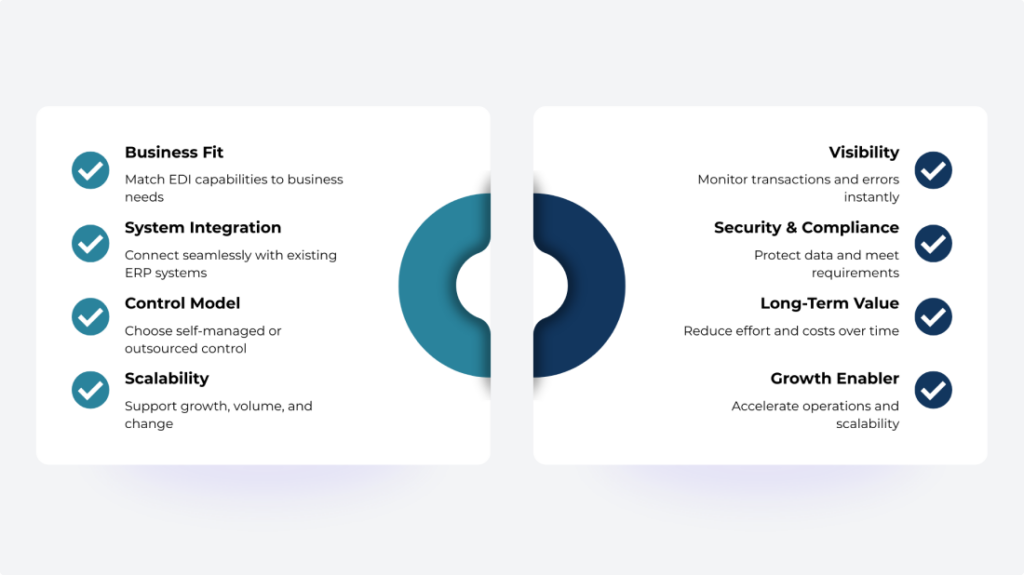
Choosing an EDI solution is not just about sending and receiving documents. The right choice determines how efficiently your business operates, how easily you scale, and how much manual effort your team carries long term.
To make the right decision, it’s important to look beyond basic EDI capabilities and evaluate how well a solution fits your business today—and where you’re headed next.
Start With Your Business Requirements
Begin by understanding what you actually need EDI to do.
Some organizations only need to exchange a small number of documents with a few trading partners. Others manage thousands of transactions across complex supply chains, multiple ERPs, or global partners. Transaction volume, document types, industry requirements, and growth plans should all shape your decision.
A solution that works for a small network may struggle as complexity increases.
Evaluate Integration With Your Existing Systems
One of the most critical factors is how well the EDI solution integrates with your ERP, accounting, warehouse, or supply chain systems.
A strong EDI solution should connect directly to the systems you already use—without requiring manual uploads, custom scripts, or fragile workarounds. The deeper and more flexible the integration, the more automation and accuracy you’ll gain.
If EDI data still requires manual handling after it’s received, the solution isn’t delivering its full value.
Consider Control vs. Outsourcing
EDI solutions generally fall into two models: managed services or self-managed software.
Managed EDI can reduce internal effort initially, but often limits flexibility and visibility over time. Changes may require support tickets, added fees, or long turnaround times.
Self-managed EDI software gives internal teams greater control over mappings, partner setup, and workflows. This approach typically offers faster changes, better transparency, and lower long-term costs—especially as your EDI environment grows.
The right choice depends on your internal resources and how much control you want to retain.
Look for Scalability and Flexibility
EDI requirements rarely stay static. New trading partners, new document types, updated standards, and higher volumes are almost guaranteed.
A future-ready EDI solution should:
- Handle growing transaction volumes without performance issues
- Support multiple EDI standards and versions
- Make it easy to onboard new partners
- Adapt quickly to changing requirements
If changes are slow or expensive, the solution may become a bottleneck rather than an enabler.
Prioritize Visibility, Monitoring, and Error Handling
EDI problems don’t always announce themselves. Missing acknowledgments, rejected documents, or silent failures can create downstream issues if they aren’t caught early.
Modern EDI solutions provide real-time monitoring, clear error reporting, and detailed audit trails so teams can see what’s happening and respond quickly. Visibility reduces risk, improves compliance, and minimizes fire drills.
Don’t Overlook Compliance and Security
Security and compliance are non-negotiable.
Your EDI solution should support secure communication protocols, enforce trading partner rules, validate documents automatically, and retain records for auditing. This protects your business from chargebacks, disputes, and regulatory exposure.
Compliance should be built into the workflow—not managed manually after the fact.
Think Long-Term, Not Just Short-Term
The lowest-cost or quickest-to-deploy EDI solution isn’t always the best choice. What matters most is how well the solution supports your operations over time.
A well-chosen EDI platform reduces manual work, lowers risk, and scales with your business—turning EDI from a maintenance burden into a strategic advantage.
The Right EDI Solution Enables Growth
Ultimately, the right EDI solution should feel less like a piece of infrastructure and more like a business accelerator.
It should simplify complexity, increase confidence in your data, and allow your teams to focus on higher-value work—not troubleshooting transactions.
With the right foundation in place, EDI becomes a powerful driver of efficiency, compliance, and growth.
Conclusion: Why EDI Still Matters in a Digital-First World
Electronic Data Interchange has been around for decades, but it remains one of the most important technologies behind modern B2B operations.
At its core, EDI is about eliminating friction—between systems, between companies, and between processes that slow business down. By standardizing how data is exchanged and integrating that data directly into business systems, EDI enables faster transactions, greater accuracy, stronger compliance, and scalable growth.
For organizations managing complex supply chains, high transaction volumes, or strict trading partner requirements, EDI isn’t just a technical necessity. It’s a strategic foundation that supports automation, visibility, and long-term efficiency.
When implemented with the right software, integration, and controls, EDI transforms how businesses operate—turning manual workflows into seamless, system-to-system automation.
EDI FAQs
EDI stands for Electronic Data Interchange. It refers to the electronic exchange of business documents—such as purchase orders, invoices, and shipping notices—between companies using standardized formats.
An EDI transaction is a single electronic business document exchanged between two systems using EDI standards. Each transaction represents a specific business action, such as placing an order (EDI 850) or sending an invoice (EDI 810).
An EDI system is the combination of software, integrations, and processes that manage the creation, translation, transmission, validation, and integration of EDI transactions between organizations.
EDI software translates internal data into EDI formats (and back again), transmits documents securely, validates compliance rules, integrates with business systems, and provides monitoring and audit capabilities.
EDI integration connects EDI transactions directly to internal systems like ERP, accounting, or warehouse management platforms. This allows data to flow automatically without manual data entry or file handling.
EDI mapping defines how data fields from internal systems align with EDI standards and trading partner requirements. Proper mapping ensures data is translated accurately and processed correctly by both parties’ systems.
EDI compliance means meeting the technical and business rules required by trading partners and industries, including document formats, security protocols, acknowledgment timelines, and audit requirements.
Yes. Despite newer technologies like APIs, EDI remains the backbone of B2B data exchange in industries such as manufacturing, retail, logistics, healthcare, and finance. Many trading partners still require EDI, and modern EDI platforms now support real-time, integrated workflows.
EDI focuses on standardized business documents and trading partner compliance, while APIs enable real-time application-to-application communication. Many modern integration strategies use both, depending on the use case.
If a business works with trading partners that require EDI—or plans to scale operations—EDI can provide efficiency and compliance benefits regardless of company size.
If your organization exchanges high volumes of orders, invoices, or shipment data with partners—or struggles with manual data entry, errors, or compliance—EDI software is likely a strong fit.