Receipts and invoices contain far more information than a vendor name and a total amount. Every line item tells part of the story, from individual products and quantities to discounts, taxes, and pricing.
Extracting that information manually is slow and repetitive. That’s why businesses are increasingly using receipt line extraction and invoice line extraction to automate data entry and improve financial accuracy. In this article, we’ll explain how line item extraction works, why it’s different from traditional OCR, and where it fits into modern accounts payable processes.
What Is Receipt Line Extraction?
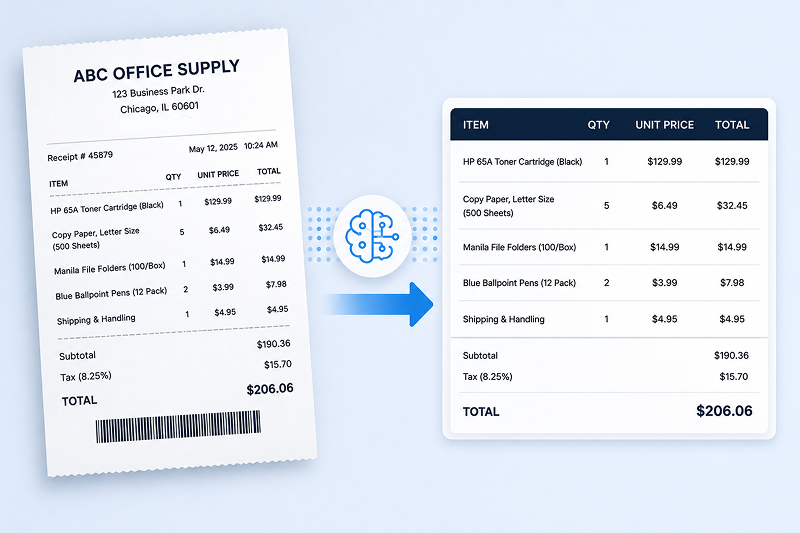
Receipt line extraction is the process of identifying and capturing every individual item listed on a receipt. Instead of reading only the vendor name, date, and total, it extracts the details for each purchased product or service.
Depending on the receipt, this may include the item description, quantity, unit price, discount, tax, SKU, and extended price. These individual records can then be imported into accounting, expense management, or ERP systems without manual retyping.
This level of detail is especially valuable for businesses that need accurate expense reporting, inventory tracking, or purchase validation.
OCR Receipt Line Item Extraction vs. Traditional OCR
Traditional OCR (Optical Character Recognition) converts an image into machine-readable text. While this is an important first step, it doesn’t understand what the text actually represents.
An OCR receipt line item solution goes much further. It identifies the table structure, associates quantities with prices, and reconstructs each line item as structured data instead of plain text.
For example, a traditional OCR engine may read:
- Widget A
- 3
- $12.50
An intelligent line item extraction system understands that those values belong together as a single purchase record.
Why Receipt Line Extraction Is Challenging
Receipts are surprisingly inconsistent.
Different vendors use different layouts, fonts, abbreviations, and formatting. Some receipts contain multi-line product descriptions, while others place discounts or taxes in unexpected locations.
Image quality creates another challenge. Folded receipts, faded thermal paper, poor lighting, and blurry mobile photos all reduce accuracy.
These variations make rule-based extraction difficult. Instead of relying on fixed templates, modern AI models analyze the overall document structure and adapt to new receipt formats automatically.
Invoice Line Extraction Solves a Similar Problem
Although invoices look different from receipts, the underlying challenge is nearly identical.
Invoice line extraction identifies every billed item, including descriptions, quantities, unit prices, shipping charges, taxes, and totals. This information can then be compared against purchase orders and receiving records during the approval process.
Manufacturers, retailers, hospitality businesses, and logistics companies often process thousands of invoices every month. Automating line item extraction reduces repetitive data entry while improving consistency across those documents.
Why Accurate Line Item Extraction Matters
Capturing line items accurately does more than eliminate manual typing.
It gives finance teams better visibility into spending by showing exactly what was purchased instead of only the invoice total. This makes reporting, budgeting, and vendor analysis much more meaningful.
Accurate line item extraction also supports faster approvals. When invoice details are already structured, businesses can automate validation instead of manually reviewing every document.
Perhaps most importantly, it reduces data entry errors that can lead to duplicate payments, incorrect coding, or reconciliation issues later in the accounting process.
How AI Improves Receipt and Invoice Line Extraction
Older OCR systems depended heavily on templates and predefined rules. Every new receipt layout often required additional configuration.
Modern AI approaches work differently.
Instead of simply recognizing characters, AI identifies relationships between values. It learns how tables are organized, recognizes columns even when they shift, and understands that prices, quantities, and descriptions belong together.
This allows businesses to process documents from many different vendors with much less manual setup while maintaining higher accuracy.
What to Look for in a Line Item Extraction Solution
Not every extraction solution delivers the same results.
When evaluating a platform, consider whether it can:
- Capture individual receipt and invoice line items accurately
- Handle multiple document layouts without template creation
- Process scanned documents, PDFs, and mobile images
- Integrate with your ERP or accounting system
- Validate extracted information before posting
- Flag exceptions instead of requiring manual review of every document
These capabilities reduce manual work while giving finance teams greater confidence in the extracted data.
Where Line Item Extraction Fits Into AP Automation
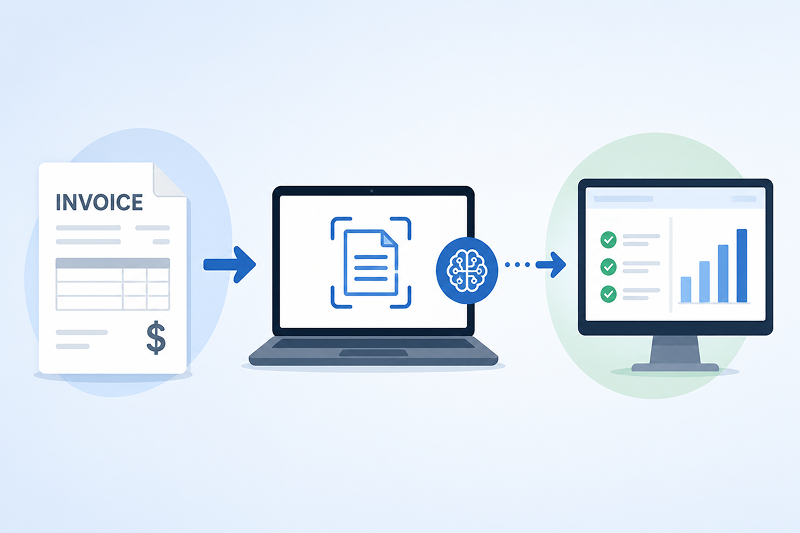
Line item extraction is often the first step in a larger automation workflow.
Once invoice data has been captured, organizations can compare it against purchase orders and receiving records, apply approval rules, and identify discrepancies before payment.
This is where AI-driven accounts payable platforms add additional value. Rather than stopping after OCR, they use extracted line items to automate invoice validation and exception handling.
For example, ACOM’s AutoLedger combines AI-powered OCR, intelligent line item extraction, and automated two-way and three-way matching to compare invoices with purchase orders and receipts. Instead of requiring someone to review every invoice manually, the system applies business rules and flags only the exceptions that require attention. This allows finance teams to spend less time on repetitive validation and more time resolving meaningful issues.
Final Thoughts
Receipt line extraction has evolved far beyond basic OCR.
Modern AI can now capture individual line items from receipts and invoices with much greater accuracy, making it possible to automate tasks that once required hours of manual effort.
As organizations continue modernizing their finance operations, accurate line item extraction will remain a critical foundation for better reporting, faster invoice processing, and more efficient accounts payable workflows.