Here’s the thing—most businesses don’t plan to drown in spreadsheets, emails, and clunky manual processes. It just… happens. One invoice at a time. One order copy-pasted (and maybe pasted wrong). Before you know it, someone’s chasing down a missing shipment while another person is fixing a typo that shouldn’t have existed in the first place. It’s messy. And weirdly common.
Across industries—manufacturing, healthcare, retail, take your pick—the same trio of headaches keeps showing up: errors, delays, and that nagging feeling that everything is taking longer than it should. Because it is.
Enter EDI. Or, less formally, a smarter way for systems to talk to each other without human middlemen fumbling the translation. At its core, Electronic Data Interchange is just the automated exchange of business documents—orders, invoices, shipping notices—between systems. No retyping. No guesswork. No “Wait, did you get my email?”
The real problem, though, isn’t just paperwork. It’s fragmentation. Disconnected systems. Slow-moving data. Costly mistakes that ripple outward.
And that’s where EDI quietly changes the game—streamlining operations, tightening accuracy, and, honestly, giving businesses a bit of breathing room again.
What Is EDI and Why It Matters for Modern Businesses
If you strip away the buzzwords—and there are plenty of them—EDI is actually pretty straightforward. It’s how businesses send documents like purchase orders, invoices, and shipping notices directly from one system to another without someone retyping everything line by line. No PDFs bouncing around inboxes. No “version 7_FINAL_final2.xlsx” nonsense. Just clean, structured data moving where it needs to go.
Sounds simple, right? It is. And yet, a lot of companies are still stuck doing things the long way.
Here’s the rub: most organizations run multiple systems—ERP, accounting, warehouse software—and those systems don’t always play nicely together. So people become the glue. They copy, paste, double-check, fix errors, resend files… over and over again. It’s tedious. It’s risky. And honestly, it’s a little outdated.
Worse, there’s often zero visibility across trading partners. You send an order and then—what? Wait. Follow up. Hope it didn’t get lost in someone else’s backlog.
That’s usually the tipping point. Businesses don’t adopt EDI because it’s trendy—they do it because the inefficiencies start costing real money. And once that happens, automation stops being optional.
Top Benefits of EDI for Businesses
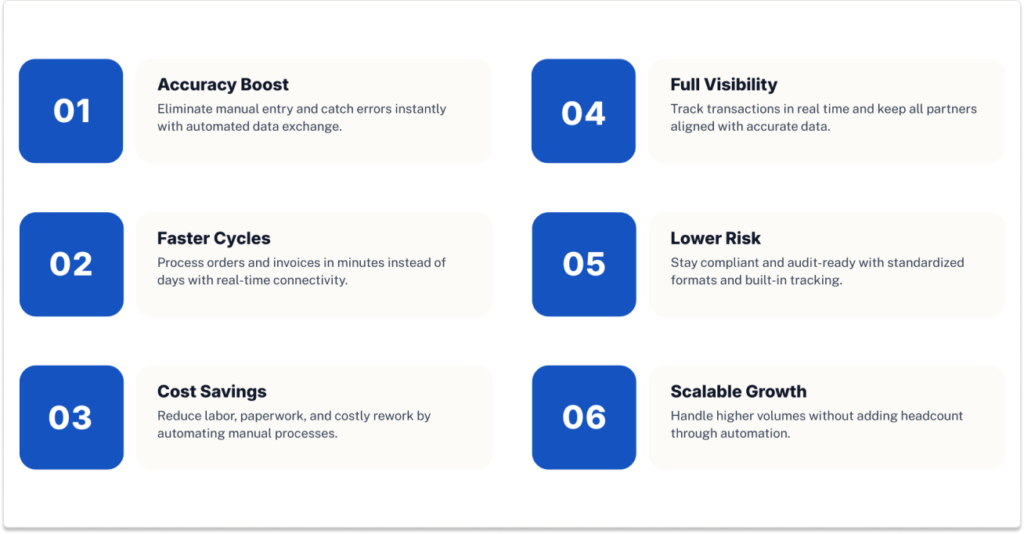
1. Eliminate Manual Data Entry and Reduce Errors
You know that sinking feeling when someone says, “Hey… this number doesn’t look right”? Yeah, that usually traces back to manual entry. It’s not that people are careless—it’s just human nature. We get tired. We rush. We copy the wrong cell.
And then the dominoes fall.
A small mistake turns into a delayed order. That delay turns into a chargeback. Suddenly, your team is burning hours fixing something that shouldn’t have existed in the first place. Compliance teams get twitchy. Finance starts asking questions. Nobody’s thrilled.
EDI quietly removes that entire layer of risk. Data flows directly between systems—no retyping, no middle step where things can go sideways. And with real-time validation baked in, errors get caught instantly, not three emails later.
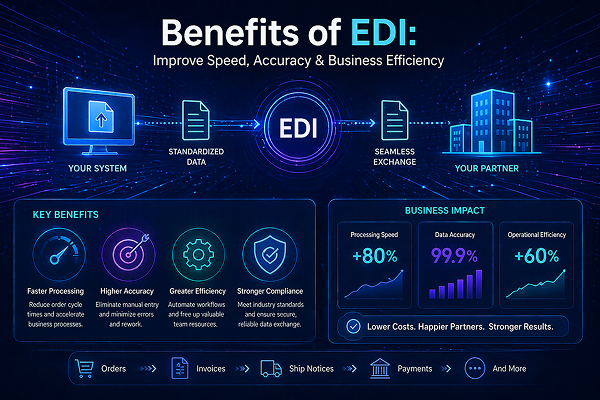
The payoff? Accuracy improves dramatically—often north of 70%. Less cleanup. Fewer headaches. Honestly, it just feels… calmer.
2. Faster Transaction Processing and Cycle Times
Let’s talk speed. Or lack of it.
In a lot of companies, orders and invoices still crawl through systems—sometimes literally taking days to process. Someone sends a file. Another person reviews it. Someone else keys it in. You get the idea. It’s like watching traffic during rush hour… painful.
Meanwhile, cash flow slows down. Opportunities slip through the cracks. And everyone’s wondering why things take so long.
EDI changes the tempo completely. Transactions move in real time—system to system, no pit stops. What used to take days can happen in minutes. Not exaggerating.
That acceleration has ripple effects. According to IBM, EDI automation can cut transaction processing times from days to minutes by enabling real-time data exchange between systems.
3. Lower Operational Costs
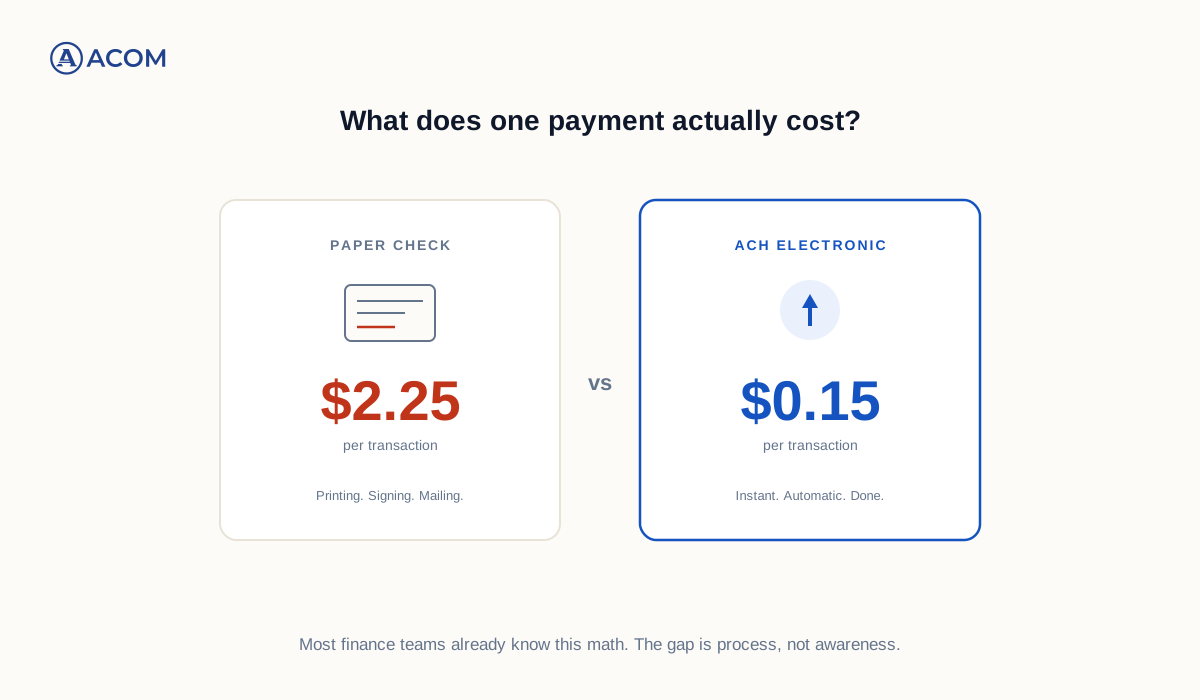
Here’s where things get a bit more blunt: manual processes are expensive. Not always obvious at first, but the costs are there—labor, paper, printing, storage, corrections, rework… it adds up in ways people don’t always track closely.
Especially in accounts payable. That’s usually ground zero for inefficiency.
When teams are stuck processing documents by hand, the cost per transaction creeps up. Slowly, quietly. Until it’s not so quiet anymore.
EDI steps in and trims the fat. Automation reduces the need for manual handling, cuts down on physical paperwork, and eliminates a lot of those hidden admin costs. Fewer people needed for repetitive tasks, fewer errors to fix, less overhead overall.
It’s not glamorous. But it’s effective.
4. Improve Supply Chain Visibility and Collaboration
If you’ve ever had to ask, “Where is that order?” more than once… you already know the problem.
Without real-time visibility, supply chains become a guessing game. You send something out, and then you wait. Maybe follow up. Maybe wait some more. Communication gaps creep in, and suddenly you’re dealing with delays that no one saw coming.
It’s frustrating—for you and your partners.
EDI brings clarity back into the picture. Transactions are tracked as they happen. Documents are visible across systems. Everyone’s working off the same information, not chasing updates.
The result? Fewer surprises. Better coordination. And, honestly, fewer awkward “just checking in” emails.
5. Enhance Compliance and Reduce Risk
Compliance isn’t exactly anyone’s favorite topic. But ignoring it? Not an option.
Different industries come with strict requirements—data formats, reporting standards, audit trails. When processes are manual, staying compliant becomes… let’s say, complicated. Mistakes happen. Documentation gets lost. Audits turn into fire drills.
And penalties? They’re not small.
EDI simplifies a lot of that complexity. Standardized formats like X12 and EDIFACT ensure consistency. Built-in tracking and audit trails make it easier to prove what happened, when, and why.
So instead of scrambling during audits, businesses stay prepared. Risk goes down. Confidence goes up. That peace of mind—hard to quantify, but definitely real.
6. Scale Operations Without Increasing Headcount
Growth is great. Until it isn’t.
Because as transaction volumes increase, so does the workload. More orders. More invoices. More everything. And without automation, the default solution is usually… hire more people.
Which works—for a while.
But it’s not exactly sustainable.
EDI allows businesses to grow without constantly expanding their teams. Automation handles the increased volume, processing transactions at scale without slowing down or introducing new bottlenecks.
So instead of throwing more bodies at the problem, companies can scale smarter. Leaner. And maybe—just maybe—without overwhelming their teams in the process.
Benefits of EDI in Supply Chain Management
Supply chains, if we’re being honest, are a bit like group projects—when communication breaks down, everything starts slipping. Orders get delayed. Inventory numbers don’t quite match reality. Someone, somewhere, is always waiting on an update that never came.
That’s where the benefits of EDI in supply chain management really start to show up.
First, speed. Orders move faster, invoices get processed quicker, and the whole order-to-cash cycle tightens up in a way that’s actually noticeable. Not theoretical—real, day-to-day improvement. And when cash flows faster, well… everything else gets easier.
Then there’s visibility. With real-time data exchange between suppliers and customers, businesses can actually see what’s happening—inventory levels, shipment status, order confirmations—all without chasing emails or refreshing dashboards like it’s a sport. It’s oddly satisfying.
Collaboration improves too. Suppliers aren’t left guessing, and buyers aren’t stuck waiting. Everyone’s working off the same, up-to-date information.
And those dreaded stockouts? Less frequent. Delays? Fewer. Not eliminated entirely—nothing’s perfect—but significantly reduced.
In short, EDI turns a reactive supply chain into something far more coordinated… and a lot less chaotic.
Benefits of EDI in Logistics
Logistics is where things either run like clockwork… or fall apart spectacularly. There’s not much middle ground. One missed update, one delayed notification, and suddenly trucks are waiting, warehouses are guessing, and customers are—well—calling.
The benefits of EDI in logistics really come down to timing and clarity. For starters, shipment notifications happen automatically. No one has to manually send updates or chase confirmations. The moment something moves, the system knows—and so does everyone else who needs to.
That alone speeds things up. Delivery coordination becomes smoother, almost intuitive. Carriers, warehouses, and customers stay in sync without the usual back-and-forth. Less friction. Fewer surprises.
And then there’s the paperwork—or, more accurately, the lack of it. Bills of lading, shipping notices, invoices—they’re all exchanged electronically. Which means fewer errors, fewer lost documents, and way less time spent fixing avoidable mistakes.
Tracking improves too. Not just “we think it’s on the way,” but accurate, real-time visibility into where things actually are.
It doesn’t make logistics effortless—nothing does—but it definitely makes it a whole lot more predictable.
Benefits of EDI in E-Commerce
E-commerce moves fast. Like, blink and you missed it fast. Customers expect instant confirmations, accurate stock levels, and deliveries that show up when promised—not “sometime next week, maybe.” And behind the scenes? It’s a constant scramble to keep everything aligned.
That’s where the benefits of EDI in e commerce really start to earn their keep.
Orders, for one, get processed almost immediately. No lag from manual entry, no bottlenecks waiting for someone to key things in. A customer clicks “buy,” and the system kicks into gear—order confirmed, inventory adjusted, fulfillment triggered. Smooth. Or at least, smoother than the old way.
Inventory updates happen in real time too, which is huge. Nothing frustrates customers more than ordering something that’s… not actually in stock. EDI helps prevent that awkward scenario.
Then there’s integration. E-commerce isn’t just one system—it’s marketplaces, suppliers, warehouses, payment platforms, all stitched together. EDI keeps those connections running without constant intervention.
And the end result? A better customer experience. Faster responses, fewer errors, more reliability. Which, honestly, is what keeps people coming back in the first place.
Benefits of EDI in Healthcare
Healthcare, unlike most industries, doesn’t really have the luxury of “getting it wrong and fixing it later.” When data is off—even slightly—the consequences can be serious. Claims get rejected. Payments get delayed. Patient records? Well, those need to be right, no exceptions.
That’s why the benefits of EDI in healthcare feel a bit more… urgent.
For starters, EDI enables the secure exchange of claims and patient data between providers, insurers, and third parties. No more faxing (yes, that still happens), no more emailing sensitive files and hoping for the best. Everything moves through standardized, encrypted channels—which is exactly what regulations like HIPAA demand.
Billing speeds up too. Claims are submitted electronically, processed faster, and reimbursements come through without the usual back-and-forth. It’s not instant, but it’s a noticeable improvement.
Accuracy improves as well. Fewer manual touchpoints mean fewer errors in patient records and billing data. And that reduces the risk of compliance issues—something no healthcare organization wants to deal with.
Is it perfect? No system is. But it’s a far more reliable way to handle data in an environment where reliability really matters.
Financial Benefits of EDI for Manufacturers
Manufacturing margins… they’re tight. Everyone knows it, even if no one likes to say it out loud. So when inefficiencies creep in—extra labor, errors, delays—they don’t just slow things down, they quietly eat into profits.
That’s where the financial benefits of EDI for manufacturers become pretty hard to ignore.
Start with processing costs. Manual handling of orders, invoices, and shipping documents takes time—sometimes a lot of it. Multiply that across hundreds or thousands of transactions, and suddenly you’ve got a serious expense on your hands. EDI cuts that down by automating the flow, reducing the need for hands-on work.
Errors drop too. And that matters more than it sounds. Fewer mistakes mean fewer chargebacks, fewer disputes, fewer costly do-overs. It’s one of those “small fix, big impact” situations.
Then there’s invoicing. With EDI, invoices go out faster, get processed quicker, and—ideally—get paid sooner. Cash flow improves, which gives manufacturers more flexibility to reinvest or simply stay afloat during slower cycles.
Inventory costs shrink as well. Real-time data helps avoid overstocking or understocking, both of which can be expensive in different ways.
It’s not magic. But financially speaking, it’s a pretty smart move.
Strategic Benefits of EDI
Here’s where things get a little less tactical and a bit more… big picture. Because beyond saving time or cutting costs (which, sure, are important), the strategic benefits of EDI tend to reshape how a business actually competes.
Speed, for one, becomes a real differentiator. When your transactions move faster than everyone else’s—orders processed instantly, shipments coordinated without lag—you’re not just efficient, you’re easier to do business with. And in crowded markets, that matters more than most people admit.
Relationships improve too. Suppliers and partners appreciate consistency—clear data, fewer errors, predictable timelines. It builds trust. And trust, in supply chains especially, is currency.
Then there’s scale. Expanding into new regions or onboarding new partners usually comes with complexity (and headaches). EDI smooths that out by standardizing communication, making global operations feel… not simple exactly, but manageable.
And maybe the most underrated piece: data. Clean, structured, real-time data opens the door to better decisions. Not guesses. Not gut feelings. Actual insights.
So yeah, EDI isn’t just an efficiency tool. It’s more like a quiet advantage—one that compounds over time.
Benefits of EDI in Electronic Transactions
Electronic transactions are supposed to be fast and seamless… in theory. In reality, they often come with their own set of headaches—security concerns, mismatched data, approvals stuck in limbo. You’d think by now we’d have figured that out completely, but here we are.
This is where the benefits of EDI in electronic transactions start to stand out.
First, standardization. EDI uses structured formats, so every transaction follows the same “language.” No ambiguity, no interpretation issues—just consistent data moving between systems. That alone eliminates a surprising amount of friction.
Security improves too. Transactions aren’t just floating around via email or unsecured channels—they’re transmitted through controlled, encrypted pathways. Which significantly reduces the risk of fraud or tampering. Not zero risk, obviously, but much lower.
Approvals speed up as well. Instead of waiting for manual reviews or back-and-forth confirmations, processes move automatically—sometimes in real time. It’s one of those things you don’t fully appreciate until you see how slow the old way was.
And accuracy? Much better. With fewer human touchpoints, there’s less chance for errors to creep in.
So while electronic transactions aren’t new, EDI makes them work the way they probably should’ve all along.
How to Maximize the Benefits of EDI with the Right Platform
Here’s the uncomfortable truth: just having EDI isn’t enough. Plenty of companies technically “use EDI” and still deal with delays, errors, and systems that refuse to cooperate. It’s like owning a sports car but driving it in first gear the whole time.
The real issue? Disconnected systems.
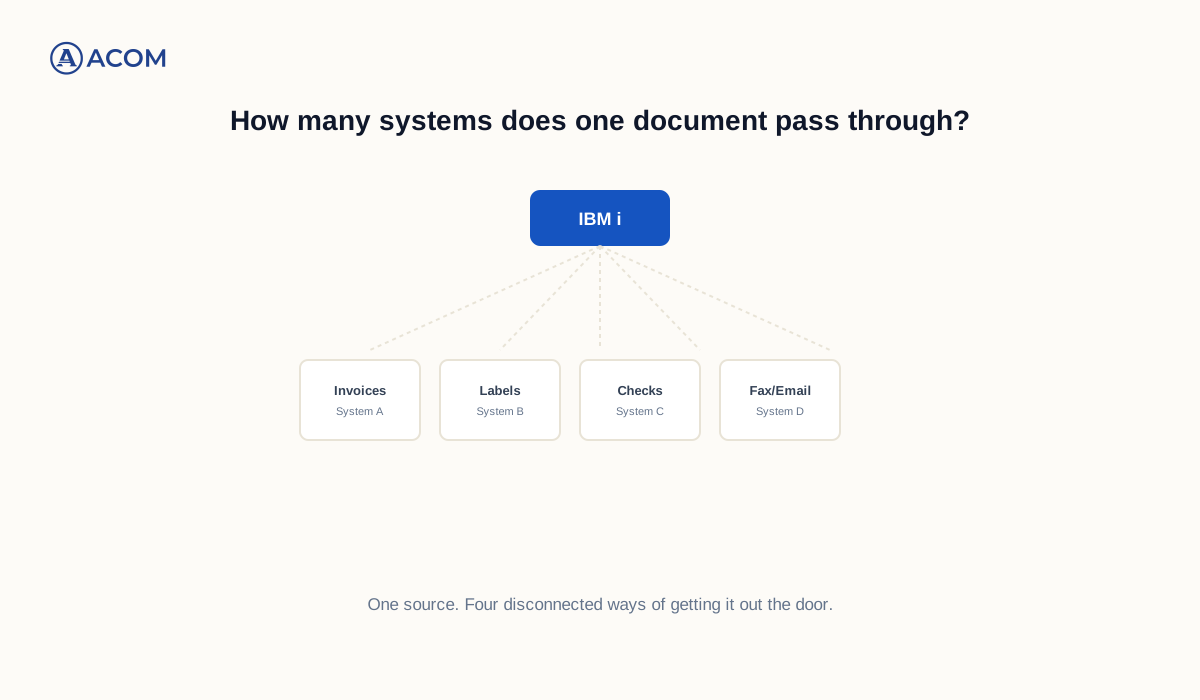
ERP over here. CRM over there. Warehouse system doing its own thing entirely. And somewhere in the middle—people manually re-entering data, fixing mismatches, chasing updates. It slows everything down. Costs creep up. Errors sneak in where they shouldn’t.
Sound familiar? Yeah, it usually does.
That’s where the right platform makes all the difference.
ACOM’s EZConnect, for example, isn’t just moving documents from point A to point B—it’s translating data between any format, connecting systems in real time, and even automating trading partner setup so you’re not stuck onboarding vendors manually every other week. It’s less “tool” and more… connective tissue.
And the results tend to speak for themselves. Transactions move faster—noticeably faster. Errors drop, often by 70% or more. Business cycles tighten up, sometimes improving by as much as 60%.
So if EDI is the engine, the platform you choose? That’s what determines whether you’re cruising… or still stuck in traffic.
Conclusion: Why EDI Is a Must-Have for Modern Businesses
At some point, it stops being a “nice-to-have” and becomes… well, obvious.
Because when you step back and look at it, the benefits of EDI aren’t subtle. Costs go down—less labor, less paper, fewer expensive mistakes. Speed picks up in ways that ripple across the entire business, from order processing to cash flow. Accuracy improves (and not just a little), which means fewer headaches, fewer disputes, fewer late-night “what went wrong?” conversations.
And scalability? That’s the quiet advantage. As your business grows, EDI grows with it—without forcing you to constantly add more people just to keep things running.
But maybe the bigger point—the one that’s easy to overlook—is this: EDI isn’t just about efficiency. It’s about staying competitive. Businesses that move faster, communicate better, and operate with cleaner data tend to… win more often. It’s not flashy, but it’s real.
So if your organization is still leaning on manual processes—spreadsheets, emails, retyping data (we’ve all been there)—it might be time to rethink things.
If your business is still relying on manual processes, now is the time to modernize.