It’s funny—people talk about supply chains like they’re these sleek, high-speed machines now. And sure, they are. Faster than ever. But also? Way messier behind the curtain.
Orders flying in from one system, invoices going out from another, suppliers somewhere across the globe using… who knows what. It’s a bit like trying to coordinate a group chat where half the people are on WhatsApp, a few are stuck on email, and one stubborn guy still prefers fax. That’s where EDI in supply chain management quietly does its job. Not glamorous. Not flashy. But absolutely essential.
At its core, EDI—Electronic Data Interchange—is just a structured way for businesses to exchange documents digitally. Purchase orders, invoices, shipping notices—all that good stuff—without human hands retyping everything line by line. Sounds simple, right? In theory, yes. In practice… not always.
Because without it, things slow down. A lot. Manual processes creep in. Someone keys in the wrong SKU. A shipment gets delayed. Suddenly you’re dealing with missed orders, chargebacks, and a whole lot of finger-pointing.
And honestly, most companies don’t realize how much friction they’re carrying until it’s too late.
That’s why automation—real automation, not just patchwork fixes—is becoming less of a “nice-to-have” and more of a survival tactic. But more on that in a bit.
What Is EDI in Supply Chain?
So—what is EDI in the supply chain, really? Not the buzzword version. The actual, day-to-day reality.
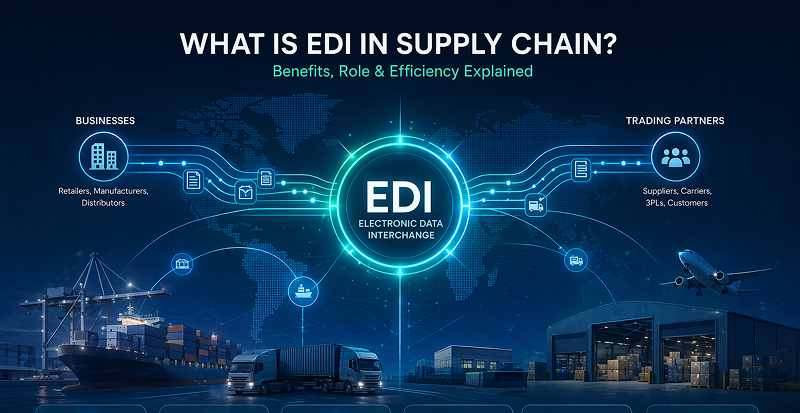
In plain terms, EDI (Electronic Data Interchange) is how businesses send each other documents in a format that machines—not humans—can read instantly. No PDFs floating around inboxes. No “Hey, can you re-send that file?” messages. Just structured data moving cleanly from one system to another, like it knows exactly where it’s going. Because it does.
Think of it this way: instead of emailing a purchase order and hoping someone on the other end types it in correctly (and quickly), EDI sends that same order directly into the supplier’s system. Automatically. No middleman. No typos. No coffee spills on printed paperwork—yes, that still happens.
The usual suspects?
Purchase Orders (POs).
Invoices.
Shipping notices—often called ASNs, if you want to sound fancy.
Here’s a simplified flow, more or less:
A company creates a purchase order → it gets translated into an EDI format → sent to a supplier → lands directly in their system → processed immediately.
Clean. Efficient. Almost boring, honestly.
Now compare that to manual document exchange. Emails get buried. Attachments go missing. Someone keys in the wrong quantity—just one digit off—and suddenly you’ve got inventory issues or billing disputes. It snowballs fast.
And the impact? Delayed shipments. Slower order fulfillment. Cash flow gets… well, stuck. Not ideal.
Which is why relying on manual processes in a modern supply chain feels a bit like using a flip phone in a world of smartphones. Technically possible. Just painfully inefficient.
How EDI Works in Supply Chain Management
Here’s where things get a little more… mechanical. Not complicated, exactly—but there’s a rhythm to how EDI works in supply chain management that’s worth understanding.
It usually starts inside an ERP system. That’s the nerve center for most companies—orders, invoices, inventory, all living there. Someone (or something) creates a document, say a purchase order. Now, instead of exporting it as a PDF or emailing it across the void, the system hands it off to an EDI layer.
From there, it gets translated. Not into French or Spanish—into a standardized EDI format that another system can actually understand. Different companies, different systems, same language. That’s the trick.
Then it’s sent off to a trading partner. Could be a supplier, a logistics provider, whoever’s next in the chain. On their end? The file is received and—this is the important part—processed automatically. No one opens it. No one retypes it. It just… flows.
Now, here’s where things diverge a bit. Some companies still run on batch processing—documents get bundled and sent at intervals. Every hour, maybe once a day. It works, technically. But it’s slow. Like waiting for a bus that only comes twice a day.
Real-time processing is different. Data moves instantly. No queues, no lag. And that’s where platforms like EZConnect come into play. It handles any-to-any data translation—EDI, XML, flat files, you name it—and pushes information directly between systems in real time. No batching. No waiting around.
Because let’s be honest—disconnected systems are still a huge headache. When data doesn’t flow, people step in. They re-key information, copy-paste between screens, double-check everything (and still miss things). That’s where errors creep in. And delays. And costs that quietly pile up in the background.
Not dramatic. Just expensive.
Benefits of EDI in Supply Chain Management
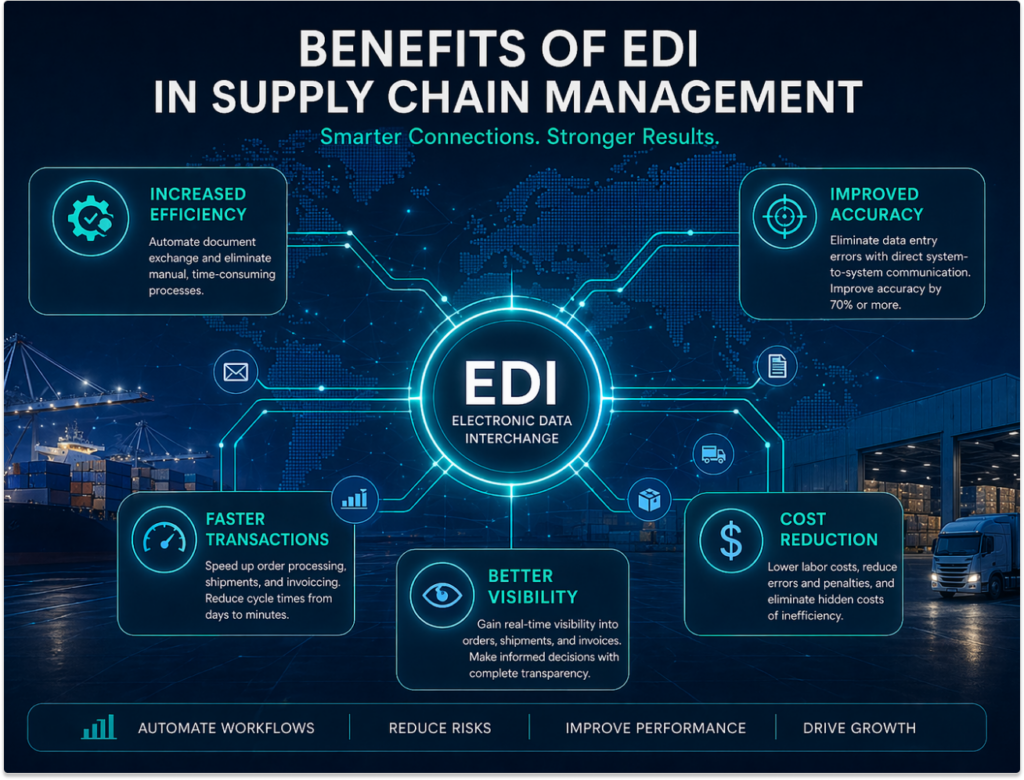
Increased Efficiency
This one’s almost too obvious, but it’s worth saying anyway. EDI strips out the busywork. No more printing, emailing, waiting, re-entering. Documents move automatically from one system to another—done.
And the difference? It’s not small. What used to take days (sometimes longer, depending on how many inboxes it got lost in) now happens in minutes. Minutes. That kind of shift changes how a business operates, not just how fast it feels.
Improved Accuracy
Humans are… imperfect. We mistype things, skip lines, transpose numbers—especially when we’re tired or rushing (which is always).
EDI removes that layer. Data flows directly between systems, no re-keying required. Error rates drop—dramatically. In some cases, you’re looking at improvements north of 70% in data accuracy. That’s not just cleaner data; it’s fewer disputes, fewer headaches.
Faster Transactions
Speed matters. A lot.
With EDI, orders get processed faster, shipments go out sooner, invoices don’t sit in limbo waiting for approval. Everything moves. It’s like clearing traffic on a highway—you don’t realize how much time you were losing until it’s gone.
Cost Reduction
Here’s the part finance teams actually care about.
Less manual work means lower labor costs. Fewer errors mean fewer chargebacks, penalties, or costly corrections. And those little inefficiencies? They add up fast—until they don’t anymore.
Better Visibility
This one’s a bit underrated, I think.
With EDI, you can actually see what’s happening. In real time. Orders, shipments, invoices—all trackable, all transparent. No more guessing or chasing updates across departments.
And that clarity? It changes decision-making in ways that are hard to quantify—but easy to feel.
EDI for Supply Chain Efficiency in Manufacturing
Manufacturing is where things get… intense. Not in a dramatic, Hollywood sense—but in volume. Constant motion. Orders stacking up, suppliers everywhere, timelines that don’t really forgive mistakes.
And this is exactly where EDI for supply chain efficiency in manufacturing starts to pull its weight.
Think about a typical manufacturer. Hundreds—sometimes thousands—of transactions moving through the system every day. Purchase orders going out, invoices coming back, shipping notices in between. Now layer in a complex supplier network: raw materials from one vendor, components from another, logistics partners coordinating deliveries. It’s a lot. Honestly, it’s a bit of a juggling act.
When those processes are manual? That’s where things wobble.
Teams end up keying in POs and invoices by hand. Supplier onboarding drags on—weeks, sometimes longer—because every new partner needs to be configured manually. It’s slow. And a little fragile.
The impact sneaks up on you. Production delays. Inventory mismatches. Suddenly you’re short on a critical component, or worse, sitting on excess stock you didn’t plan for. Neither scenario is great.
This is where something like EZConnect starts to make a noticeable difference. It automates trading partner onboarding—no more drawn-out setup cycles—and connects ERP systems, WMS platforms, and suppliers in real time. Everything talks. Instantly.
The result? Business cycles speed up—by as much as 60% in some cases .
Which, in manufacturing terms, can mean the difference between hitting a deadline… or scrambling to explain why you didn’t.
EDI Error Rate in Supply Chain
Let’s be honest—errors in supply chains don’t usually explode all at once. They creep in. Quietly. One wrong digit here, a missed field there… and suddenly you’re untangling a mess that shouldn’t have existed in the first place.
So when people ask about the EDI error rate in supply chain, what they’re really asking is: how much chaos can we avoid?
With manual processes, error rates are—well—higher than most teams would like to admit. Typos happen. Duplicate entries slip through. Someone copies the wrong product code, or an invoice doesn’t quite match what was ordered. It’s human. But it’s also expensive.
Common issues?
Incorrect product codes.
Mismatched invoices.
Shipping errors that send goods to the wrong place—or the right place at the wrong time.
And every one of those mistakes creates friction. Delays. Rework. Awkward phone calls.
EDI changes that equation. Not perfectly—nothing ever is—but dramatically.
Because instead of relying on people to catch every detail, the system handles validation automatically. If something doesn’t match, it gets flagged. Held back. Reviewed before it becomes a bigger problem. That’s exception handling in action.
So yeah, errors don’t disappear entirely—but they drop. A lot.
And more importantly, the impact of those errors shrinks. Which, in a fast-moving supply chain, might be the bigger win anyway.
Common Challenges of EDI in Supply Chain
For starters, there’s the legacy system issue. A lot of companies—especially in manufacturing and distribution—are still running on older ERP platforms. They work fine, mostly. But plugging modern EDI into them? That can feel like trying to connect a smart TV to a VCR. Possible, sure. Smooth? Not always.
Then you’ve got integration complexity. Different data formats, different standards, different partner requirements—it’s rarely a one-size-fits-all setup. Sometimes it’s more like ten sizes at once, stitched together.
And onboarding new trading partners? That can drag. Weeks of configuration, testing, back-and-forth emails. By the time everything’s live, the business has already moved on to the next priority.
The real problem, though, is rigidity. Systems that can’t adapt quickly tend to slow everything down. Adoption stalls. Efficiency gains—what you were aiming for in the first place—never fully materialize.
Which is frustrating. Because you know there’s potential there.
That’s why more companies are starting to look for something different—platforms that are flexible, scalable, and, frankly, easier to work with. Not just functional. Usable.
How Modern EDI Solutions Solve These Challenges
Modern EDI isn’t built like the stuff from 15 years ago. It’s faster. More flexible. A little less… painful to deal with.
For one, there’s real-time integration. Data doesn’t sit around waiting for the next batch window—it moves immediately. Orders, invoices, shipping updates—all flowing as they happen. That alone can shave hours (sometimes days) off a process.
Then there’s no-code or low-code mapping. Instead of relying on developers to write custom scripts every time something changes, teams can visually map data fields. Drag, drop, done. Well—mostly done. There’s still some nuance, but it’s far less of a bottleneck.
And partner onboarding? That’s no longer a drawn-out ordeal. Automated setup means new suppliers can be connected faster, without weeks of back-and-forth configuration.
This is where solutions like EZConnect come into play. It eliminates manual data entry entirely, reduces errors by over 70%, and enables real-time data flow across ERP systems, warehouses, and trading partners .
The outcome feels almost… obvious.
Faster operations. Fewer mistakes. Supply chains that actually respond in real time instead of playing catch-up.
Not perfect, maybe. But a whole lot closer.
Conclusion: Why EDI Is Essential for Supply Chain Success
And maybe that’s the simplest way to put it—EDI isn’t just some back-office tool anymore. It’s kind of the quiet engine keeping modern supply chains from falling apart.
Because when you step back, it all comes down to three things: efficiency, accuracy, and speed. EDI trims the fat from processes, removes human error from the equation (or at least most of it), and keeps information moving without the usual stop-and-start friction. Not perfectly, sure—but far better than the alternative.
And the alternative? Manual processes. Spreadsheets. Emails. Bottlenecks waiting to happen.
The companies that lean into automation—really lean into it—tend to pull ahead. Faster response times. Fewer mistakes. Better relationships with partners. It adds up, even if it doesn’t always look dramatic on the surface.
So if your supply chain still feels a bit… sluggish, or overly dependent on workarounds, it might be worth taking a closer look. Solutions like EZConnect aren’t just about “modernizing”—they’re about removing the invisible friction that slows everything down.
And once that friction’s gone? Things just move.