Somewhere between “this shouldn’t take long” and “why is this still not done?”—that’s where invoice processing usually lives.
If you’ve ever sat in an accounts payable office (or, honestly, just hovered nearby), you’ve probably seen it: PDFs piling up in inboxes, paper invoices wandering across desks like lost tourists, someone chasing approvals over email for the third time. It’s… not elegant. Not even a little.
And yet, this whole thing—invoice processing—is the quiet backbone of how businesses actually pay their bills.
Let’s unpack it. Not in a stiff, textbook way. In a real way.
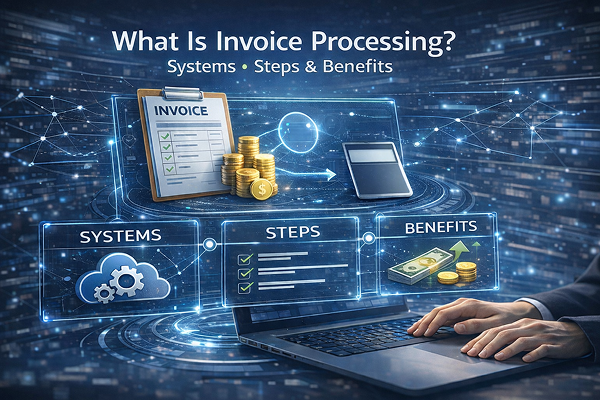
What Is Invoice Processing?
At its core, invoice processing is pretty straightforward. Receive an invoice. Check it. Approve it. Pay it. Done.
Except… it’s rarely that clean.
Invoice processing (or if we want to be precise, accounts payable invoice processing) is the entire lifecycle of handling supplier invoices—from the moment they arrive to the moment money leaves your account.
Sounds simple. It isn’t.
Because in practice, each invoice is a tiny puzzle:
- Is this amount correct?
- Does it match the purchase order?
- Who needs to approve it?
- Why is it missing a line item again?
Multiply that by hundreds—or thousands—of invoices per month. Now it’s chaos with a spreadsheet.
So, Why Does Invoice Processing Even Matter?
Short answer? Money. Long answer… still money, but with consequences.
Mess up invoice processing, and you get:
- Late payments (vendors get cranky—understandably)
- Duplicate payments (no one likes paying twice)
- Missed discounts (free money… gone)
- Compliance headaches (auditors love that)
It’s not just admin work. It’s financial control. It’s trust. It’s operational sanity.
And yet, many companies still treat it like a back-office chore. Which—if I’m being honest—is a bit like ignoring a leaky pipe because it’s “not urgent.”
How Invoice Processing Actually Works (In Real Life)
Let’s walk through it. Not the polished version—the real one.
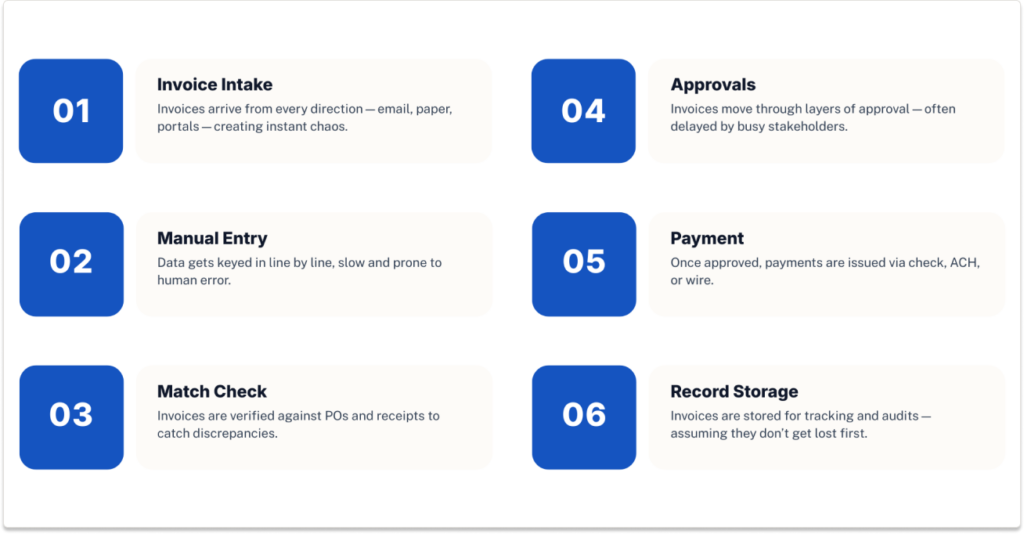
1. Invoice Receipt
Invoices come from everywhere. Email. Paper. Portals. Fax (yes, still).
Already messy.
2. Data Entry
Someone reads the invoice and types it into the system. Line by line. Carefully. Hopefully.
This alone can take minutes per invoice—sometimes longer if things don’t match.
3. Validation & Matching
Now comes the detective work:
- Does it match the purchase order?
- Were the goods actually received?
- Is the pricing correct?
This is where things slow down. Fast.
4. Approval Workflow
The invoice gets routed to managers. Sometimes one. Sometimes five.
And someone is always out of office.
5. Payment Processing
Finally—finally—it gets paid. Check, ACH, wire, whatever the company uses.
6. Record Keeping
Filed away. Or lost. Or buried in a folder named “Invoices_FINAL_v3_revised.”
Where It All Falls Apart
Here’s the uncomfortable truth: most invoice processing systems aren’t systems at all. They’re patchworks.
Manual entry. Email chains. ERP workarounds. Sticky notes (I wish I were kidding).
And the cracks show:
- Invoices get misplaced
- Approvals stall for days
- Data entry errors creep in
- Payments get delayed
It’s slow. Expensive. And oddly fragile.
In fact, manual invoice processing can cost anywhere from $11 to $30 per invoice, depending on complexity.
That adds up. Quickly.
What Is an Invoice Processing System?
Now we get to the modern fix.
An invoice processing system is software that automates all—or at least most—of that messy workflow.
Instead of juggling emails and spreadsheets, everything flows through a structured process:
- Capture → Validate → Approve → Pay → Archive
Neat. Predictable. Trackable.
Or at least, that’s the idea.
Not All Systems Are Created Equal
Some systems just digitize the mess. Others actually fix it.
You’ll typically see three flavors:
1. Manual / Paper-Based Systems
Old-school. Labor-heavy. Error-prone.
Still surprisingly common.
2. Basic Digital Systems
Invoices are stored digitally, but processes remain manual.
Better… but not great.
3. Automated Invoice Processing Systems
This is where things get interesting:
- Data capture is automatic
- Approvals are routed intelligently
- Matching happens in seconds
Less chasing. Less guessing. Less… frustration.
The Real Benefits (Not Just Marketing Talk)
Let’s skip the buzzwords for a second.
When invoice processing is automated, a few things happen:
Costs Drop
Companies can reduce invoice processing costs significantly—sometimes by over 70%.
That’s not a rounding error. That’s real money.
Errors Shrink
No more fat-finger typos or duplicate entries. Or at least far fewer.
Payments Speed Up
Invoices that used to take weeks can move through in days. Sometimes faster.
Visibility Improves
You actually know where an invoice is. At any moment. Imagine that.
But Here’s the Catch…
Even with automation, one problem keeps popping up.
Disconnected systems.
Your ERP lives in one place. Your invoices in another. Your supplier data somewhere else entirely. So what happens?
People re-enter data.
Again.
And again.
And again.
It’s tedious—and it introduces errors. Every single time.
Why Integration Changes Everything
This is where things quietly shift from “better” to “actually good.”
When systems are integrated—properly integrated—data flows automatically between them.
No re-keying. No duplication. No weird mismatches.
Solutions like real-time integration platforms (say, something like EZConnect) allow data to move seamlessly between ERP systems and external sources, cutting down errors and speeding everything up dramatically
And honestly? This is often the missing piece.
Automation without integration is just… faster chaos.
Choosing the Right Invoice Processing System
If you’re shopping around—and many companies are—it’s tempting to look at features first.
Don’t.
Start with outcomes:
- Will this reduce manual work?
- Will it integrate with our ERP?
- Will it scale as we grow?
Then look at:
- Automation capabilities
- Ease of use (important—people actually have to use it)
- Compliance and audit trails
And maybe ask yourself:
“Will this make my team’s life easier… or just different?”
Because there’s a difference.
A Few Hard-Learned Best Practices
Not theory. Just things that tend to work.
- Centralize invoice intake. No more scattered inboxes.
- Automate approvals. Humans forget—systems don’t.
- Digitize documents. Paper is… unreliable.
- Integrate everything. Seriously. Everything.
It’s not glamorous. But it works.
Why Businesses Are Finally Paying Attention
Something has shifted recently. Maybe it’s digital transformation fatigue. Maybe it’s economic pressure.
But companies are realizing:
Manual AP processes don’t scale.
They just don’t.
And as invoice volumes grow, complexity grows with it. Faster. Messier.
Automation—and more importantly, smart automation—is becoming less of a “nice to have” and more of a survival tool.
So… Where Does This Leave Us?
Invoice processing isn’t going away. If anything, it’s getting more complex.
More suppliers. More formats. More data.
The question isn’t whether to improve it. It’s how long you can afford not to.
Because eventually—usually sooner than expected—the inefficiencies catch up. In costs. In delays. In frustration.
And at that point?
Fixing it isn’t optional anymore.