Somewhere between “we’ll just email the spreadsheet” and “why did that order never go through?”—that’s where a lot of companies quietly stumble. And it’s not because they’re careless. It’s because the rules changed. Fast.
These days, trading partners don’t just prefer structure… they demand it. Strict formats. Specific protocols. Deadlines that don’t budge. Miss one tiny detail and—boom—the transaction gets kicked back like a bad check. Frustrating, right?
Here’s the thing. Many businesses are still leaning on manual processes—copying data, rekeying invoices, double-checking entries at 4:57 PM on a Friday. It works… until it doesn’t. Errors creep in. Delays stack up. And compliance? Well, that starts to feel more like a moving target than a standard you can actually hit.
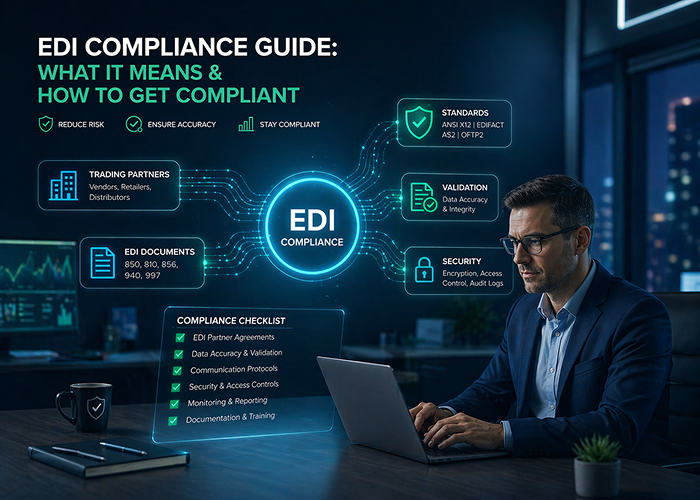
That’s where EDI compliance enters the conversation—not as some buzzword, but as a necessity. It’s what keeps data flowing cleanly, securely, and without those maddening interruptions. In simple terms, it aligns your systems with strict EDI requirements so your transactions don’t just go out… they go through.
And honestly, in today’s environment, that difference matters more than most people realize.
What Is EDI Compliance?
So—what is EDI compliance, really? Not the buzzword version. The real, slightly messy, behind-the-scenes reality.
At its core, EDI compliance simply means your business is playing by the agreed-upon rules when exchanging data electronically. That’s it. Well… not quite that simple, but close. It involves meeting specific EDI requirements—formats, protocols, and partner expectations—so that your data doesn’t just leave your system, but actually lands where it’s supposed to, intact and usable.
Now, here’s where it gets a bit technical (bear with me). Different industries—and even individual trading partners—rely on standardized formats like X12, EDIFACT, or sometimes XML. Think of these as languages. If you send English to someone expecting French… things go sideways. Fast.
Then there’s the “how” of sending that data. Communication protocols like AS2, FTP, or APIs act like the delivery trucks. Some are secure, some are faster, some are just… legacy holdovers that refuse to disappear.
And just to keep things interesting, every trading partner tends to have their own quirks. Slight tweaks. Unique validation rules. A missing field here, a formatting issue there—and suddenly your transaction is rejected. No warning. Just gone.
Which leads to the real business impact: delays, penalties, strained relationships. Sometimes all three at once.
That’s why solutions like ACOM’s EZConnect exist—it quietly handles those complexities, ensuring compliance with major standards and automatically validating transactions before they become problems. Honestly, it’s the difference between hoping things work… and knowing they will.
What Does EDI Compliant Mean?
Alright—let’s slow this down for a second, because this is where people think they understand it… and then something breaks in production.
When someone says a business is EDI compliant, what they really mean is this: your system can send and receive data exactly the way your trading partners expect. No surprises. No weird formatting hiccups. No “close enough.” It either matches—or it doesn’t.
But that simple phrase—EDI compliant—actually carries a bit of weight.
First, there’s format compliance. Your documents (purchase orders, invoices, shipping notices) have to follow strict structures like X12 or EDIFACT. Not “mostly right.” Precisely right.
Then comes data accuracy. A missing digit, a misplaced decimal… it sounds minor, but it can throw off an entire transaction. And yes, it happens more often than people like to admit.
Timing matters too. Some partners expect documents within minutes. Others allow a window. Miss it, and things start to unravel—quietly at first, then all at once.
And finally, acknowledgments—like the infamous 997. These are essentially digital receipts confirming, “Hey, we got your document, and it passed validation.” No acknowledgment? That’s a red flag.
Here’s the harsh reality: incorrect formats lead to rejected orders… which lead to delayed revenue. Sometimes lost revenue.
So if you’re still wondering what does EDI compliant mean—it means your data flows smoothly, gets accepted the first time, and keeps your business moving. Anything less? It’s friction you can’t really afford.
What Is EDI Capable vs. EDI Compliant?
This is where things get… a little murky. And honestly, a lot of teams trip over this distinction without even realizing it.
Being EDI capable sounds impressive, right? It basically means your system can send and receive electronic data. The pipes are there. The lights are on. You’ve got the basic infrastructure in place to exchange documents electronically. Great start.
But—here’s the catch—that doesn’t mean you’re actually EDI compliant.
Compliance is a different beast. It’s not just about sending data; it’s about sending it correctly, in the exact format, structure, and timing your trading partners demand. Every field. Every segment. Every rule. No shortcuts.
Think of it like this: you might be able to speak the language (EDI capable), but if your grammar is off and your accent confuses everyone… the message doesn’t land (not compliant).
A quick example: your system generates an invoice and sends it via EDI. Technically, success. But if it fails validation—maybe a required field is missing or formatted incorrectly—the partner rejects it. Just like that. So yes, you’re capable… but not compliant.
And here’s the uncomfortable truth—many businesses assume they’re compliant simply because they’re “doing EDI.” In reality, they’re only halfway there. Close enough isn’t good enough in this world.
Common EDI Compliance Requirements
If you’ve ever tried to pin down EDI requirements, you already know—they’re not one-size-fits-all. Not even close. It’s more like a layered cake… with each layer having its own rules, quirks, and occasional headaches.
Let’s break it down.
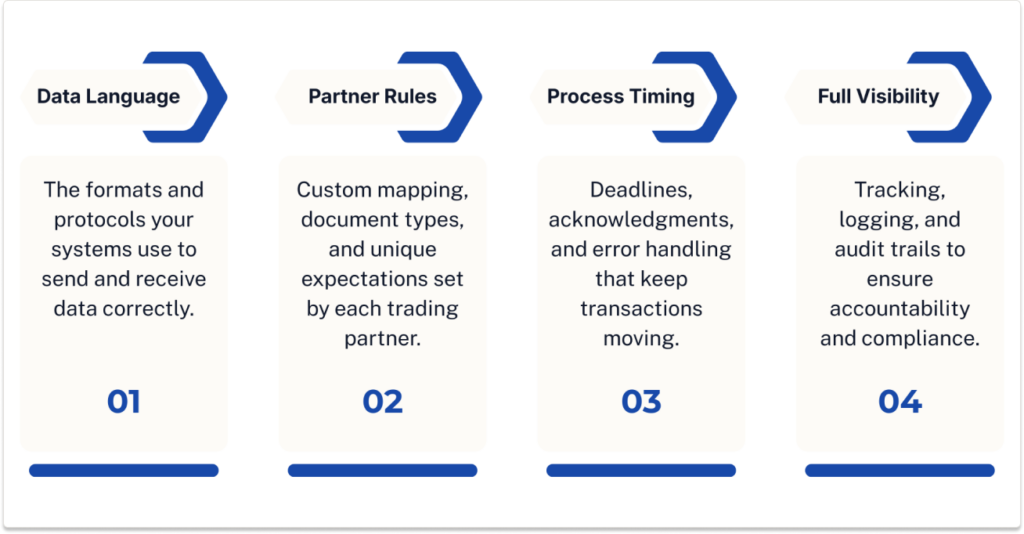
Technical Requirements
At the foundation, you’ve got the technical side of EDI compliance. This is where formats like X12 or EDIFACT come into play—the “languages” your systems must speak fluently. On top of that, there are communication protocols—AS2, FTP, APIs—basically how the data travels. Get either of these wrong, and your message might never arrive… or worse, arrive broken.
Business Requirements
Now things get personal. Each trading partner tends to have their own mapping rules—custom fields, specific structures, little preferences that aren’t always documented clearly (fun, right?). Add in required document types—purchase orders, invoices, ASNs—and suddenly you’re juggling more variables than expected.
Operational Requirements
Timing matters. A lot. Many partners enforce SLAs—send this document within X hours or risk penalties. And when something goes wrong (because it will, eventually), error handling and acknowledgments like 997s become critical. Without them, you’re basically flying blind.
Compliance & Audit
Finally, there’s the oversight layer—tracking, logging, data retention. Who sent what? When? Was it received? Approved? These aren’t just nice-to-haves—they’re often mandatory.
This is where solutions like EZConnect quietly shine, providing detailed audit trails and document-level tracking so you’re not guessing—you actually know what’s happening across your EDI environment.
Challenges of Achieving EDI Compliance
Here’s the part nobody really brags about—because getting to EDI compliance isn’t just a flip-the-switch moment. It’s messy. Sometimes painfully so.
Manual Data Entry → Errors, Rejections, Lost Time
Let’s start with the obvious culprit. Manual entry. Still everywhere. Someone’s typing invoice data into a system, double-checking fields, maybe cross-referencing a PDF on another screen… and inevitably, something slips. A digit off. A field skipped.
Result? Mismatched data, rejected transactions, and that awkward “why didn’t this go through?” conversation.
Disconnected Systems → Delays and Zero Visibility
Now layer in systems that don’t quite talk to each other. ERP over here, warehouse system over there, maybe a legacy platform hanging on for dear life. Data gets passed around like a note in class—slow, fragmented, occasionally lost.
The impact? Delays pile up, and visibility disappears. You’re reacting instead of managing.
Complex Partner Onboarding → Slow Starts
Then there’s onboarding new trading partners. In theory, it’s straightforward. In reality? Weeks… sometimes months. Mapping fields, testing formats, fixing errors—it drags. And until it’s done, business just kind of… waits.
Changing Requirements → Moving Targets
And just when you think you’ve got everything aligned, requirements change. New rules. Updated formats. Different validation criteria. Keeping up feels like chasing something that won’t stand still.
All of this—every single piece—feeds into bigger issues: revenue delays, strained relationships, operational friction. It’s not just technical noise. It hits the business where it hurts.
How to Become EDI Compliant
So… how do you actually get there? How do you go from “we kinda do EDI” to fully EDI compliant without losing your sanity in the process?
It’s not a straight line. But there is a path.
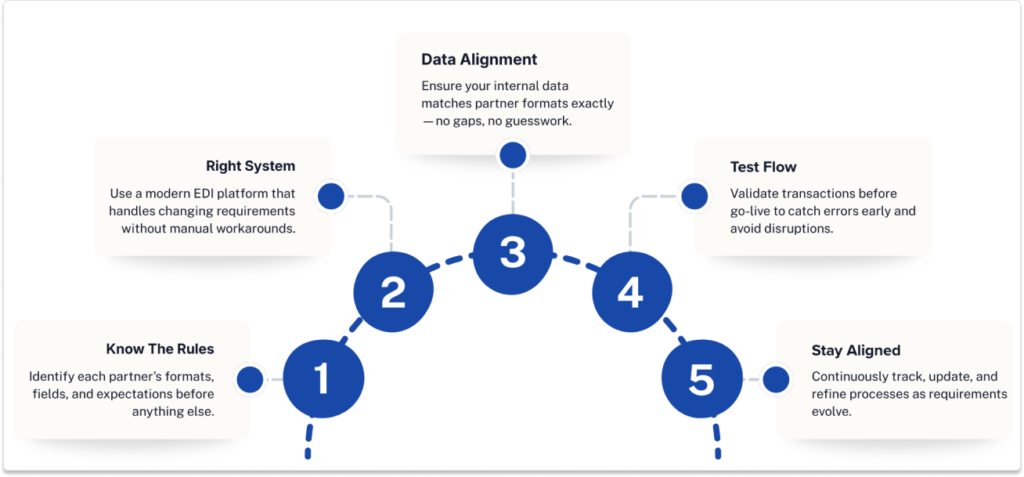
Step 1: Understand Partner Requirements
This sounds obvious—almost too obvious—but it’s where most things go sideways. Every trading partner has their own specs. Formats, fields, timing rules, validation quirks. Some document it well. Others… not so much.
Skip this step, or rush it, and you’ll be fixing issues later. Guaranteed.
Step 2: Choose the Right EDI Solution
Here’s a bit of tough love: manual processes and patchwork tools won’t cut it anymore. They just won’t.
You need a system built for this—something that can handle changing EDI requirements without constant firefighting. Otherwise, you’re basically duct-taping your way to compliance.
Step 3: Map Data Correctly
This is where things get technical—and a little tedious. Your internal data has to align perfectly with your partner’s expected formats. Not “close.” Exact.
Mapping is often where errors hide, quietly waiting to cause trouble later.
Step 4: Test Transactions (Then Test Again)
Before going live, you test. Then you test again. And maybe once more, just to be safe.
Because a failed transaction in production? That’s a whole different level of headache.
Step 5: Monitor and Maintain Compliance
Here’s the part people don’t always expect—compliance isn’t a one-time achievement. It’s ongoing. Requirements change. Partners update specs. Systems evolve.
You have to keep watching, adjusting, refining.
This is where platforms like EZConnect start to feel less like a “tool” and more like a safety net—it automates mapping, validates transactions in real time, and even simplifies partner onboarding. Fewer errors. Faster compliance. Less guesswork.
And honestly, if you’re wondering how to become EDI compliant… it’s less about doing everything manually—and more about having the right system doing the heavy lifting for you.
How Automation Simplifies EDI Compliance
Let’s be honest for a second—trying to manage EDI compliance manually is a bit like balancing a dozen spinning plates while someone keeps adding more. It can be done… but not for long.
Problem → Impact → Solution (the real story)
The problem?
Manual compliance processes are slow. Painfully slow. And worse—they’re fragile. One small mistake, one missed update, and suddenly things start breaking in ways that aren’t always obvious right away.
The impact?
It shows up where it hurts most. Delays in processing. Chargebacks from partners. Revenue that should’ve landed… but didn’t. And those little inefficiencies? They add up—quietly draining time, money, and patience.
Now, here’s where automation changes the game.
The ACOM solution: EZConnect
Instead of patching problems after the fact, EZConnect handles compliance proactively. It translates data across formats—EDI, XML, APIs—without needing constant human intervention. It integrates systems in real time, so you’re not waiting on batch processes or chasing down missing files.
New partner onboarding? Automated.
Errors? Flagged instantly through exception-based handling—no more digging through logs at midnight trying to figure out what went wrong.
The results?
This is where it gets interesting. Businesses typically see error rates drop by 70% or more, while transaction speeds improve by up to 60%. That’s not just a technical win—it’s operational breathing room.
And maybe that’s the real takeaway. Automation doesn’t just simplify compliance—it turns it from a constant struggle into something… predictable. Reliable. Almost boring, in a good way.
Benefits of Being EDI Compliant
Most companies don’t pursue EDI compliance because it sounds exciting. They pursue it because the alternative is… chaos. Quiet, expensive chaos.
But once you are compliant? That’s when things start to click.
For one, order processing speeds up. Dramatically. Transactions move through systems without getting stuck in validation loops or bouncing back for corrections. It’s smoother—almost suspiciously smooth at first.
Then there’s data accuracy. Fewer manual touchpoints mean fewer mistakes. No more “wait, which version is correct?” moments. And fewer errors naturally lead to fewer disputes, which—let’s be honest—nobody enjoys dealing with.
Something else happens too, kind of subtly: partner relationships improve. When your data is consistent, timely, and correct, partners trust you more. They stop double-checking everything. Communication gets easier. Less friction all around.
And risk? It drops. You’re no longer constantly worrying about missing a requirement or failing an audit. That background anxiety—yeah, it fades.
But maybe the biggest shift is visibility. You actually see what’s happening across your transactions in real time. No guessing. No scrambling.
All of this ties back to real business outcomes—faster order-to-cash cycles, fewer errors, fewer headaches. It’s not just compliance. It’s momentum.
Conclusion: Why EDI Compliance Can’t Be Ignored Anymore
And maybe that’s the real takeaway here—EDI compliance isn’t optional anymore. Not if you’re doing business in a modern, connected B2B environment. It’s the baseline. The expectation. The thing that quietly determines whether your operations run smoothly… or constantly feel like they’re one step behind.
Because manual processes? They don’t scale. Not really. They bend, they stretch, and eventually they break—usually at the worst possible moment. More partners, more transactions, more complexity… and suddenly what used to “work fine” becomes a bottleneck.
So the question isn’t whether to improve your EDI processes. It’s how quickly you can do it without disrupting everything else.